Be careful who you hire to dress your military. The wrong choice could cost the country’s security (and soft-power influence)
The old adage of keeping your friends close and your enemies closer might not apply when procuring military uniforms.
It would be unwise to vault too confidently aboard a high horse about the propriety of buying clothing manufactured in China – after all, most of us own at least a few garments made there. But it’s still prudent to be a bit picky where one specific branch of public-sector employees is concerned. The UK’s Ministry of Defence has recently been considering bids to furnish new uniforms for the British Armed Forces – a process that has served as a reminder that previous winners of such tenders often subcontracted the work to Chinese manufacturers.
You don’t need to be overly paranoid to perceive the potential problem here. Several countries’ militaries – those of the US and Germany, for example – have experimented with embedding tracking devices into some of their own soldiers’ uniforms. It’s not at all hard to imagine a rival power doing something similar to the uniforms of its adversaries. Indeed, it’s quite difficult to imagine them not doing it. In 2024 the British Army delayed the introduction of Chinese-made cap badges over fears that they might have been rigged in exactly this manner.
Some cholerically conservative UK newspapers have been predictably delighted by all of this. The Telegraph solicited a quote from Iain Duncan Smith, a former leader of the Conservative Party, who thundered that it was “astonishingly stupid” and “tantamount to having our uniforms made by Nazi Germany in the 1930s”.
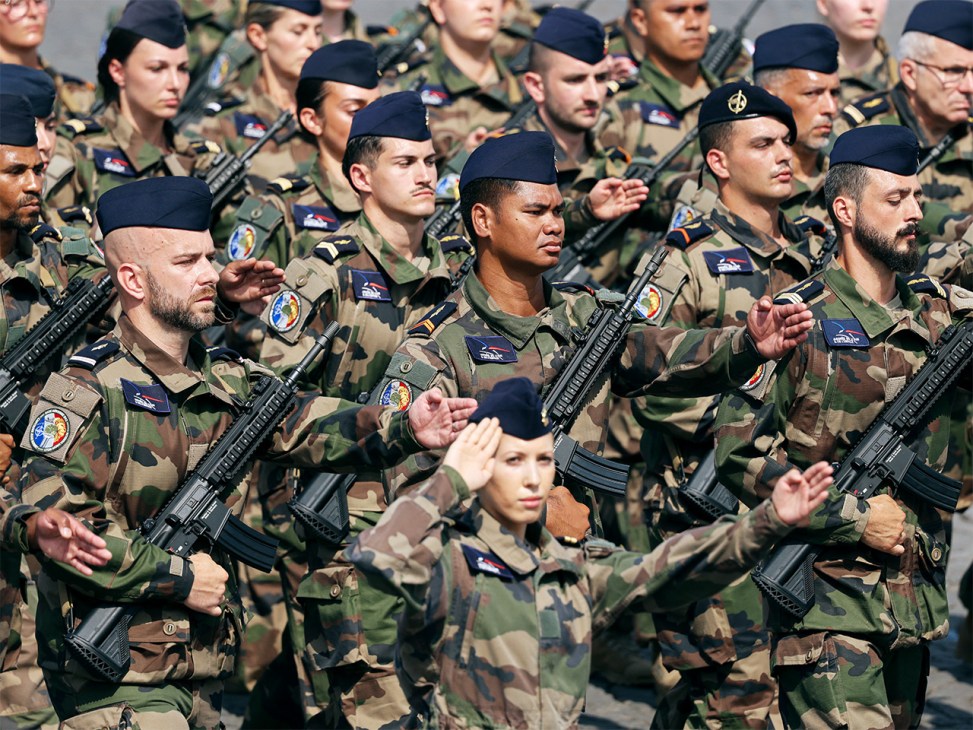
A bit of a reach – but there is a point here. A uniform is about as fundamental as military kit gets. It therefore seems unwise to allow its supply to be even slightly dependent on a country that yours could conceivably end up fighting.
It’s not as though the UK is incapable of making this stuff. AW Hainsworth of West Yorkshire has been outfitting British soldiers since before the Charge of the Light Brigade (and has done similar for the Danish, Swedish and Australian militaries). Firmin & Sons of Birmingham has been at it even longer: founded in 1655 and now part of Firmin House, it’s one of the 10 oldest continuously extant British companies of any kind and currently supplies ceremonial uniforms and battlefield kit to 34 other countries. A UK government that’s serious about encouraging homegrown manufacturing – as the administration of the current prime minister, Andy Burnham, claims to be – would be backing a win-win proposition by directing this business towards such suppliers.
Some of the UK’s Nato allies have set an example. France’s uniforms are made by French manufacturer Paul Boyé, which in 2024 supplanted the also French Marck & Balsan. The Bundeswehr is substantially dressed by German company Hexonia. Canada bet big on local produce in 2022, awarding a 20-year contract for combat clothes, kit and footwear to Logistik Unicorp of Quebec – a CA$3.7bn (€2.3bn) investment that created jobs as well as bolstering homeland security.
But there are (or so we might hope) concerns beyond the strategic and commercial. Conditions in Chinese clothing factories are rarely praised as examples of enlightened labour standards; countries engaged in defending Western values should not be subsidising those who undercut them. And though the people who wear military uniform are the personification of hard power, when we buy those garments from elsewhere, an important soft-power opportunity is squandered. A soldier, especially when serving overseas, is also an ambassador. In every respect, their country should do its utmost to make them look good.
Andrew Mueller hosts Monocle Radio’s ‘The Monocle Daily’ and ‘The Foreign Desk’.