As the country rethinks its defence strategy, the Swedish Army Band marches to a new tune
Meet the band providing the soundtrack to Sweden’s efforts to modernise its defences and reinvent the role of its military.
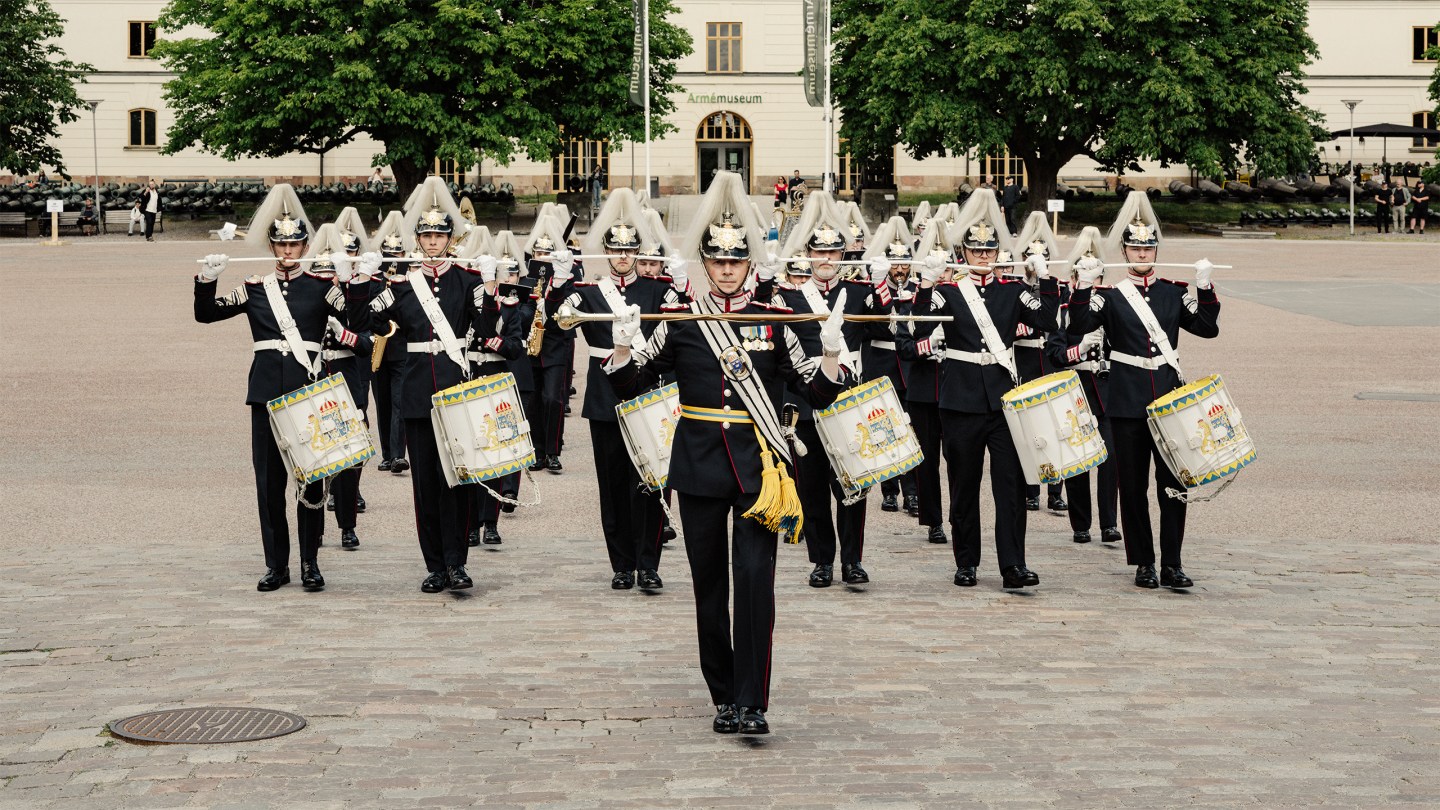
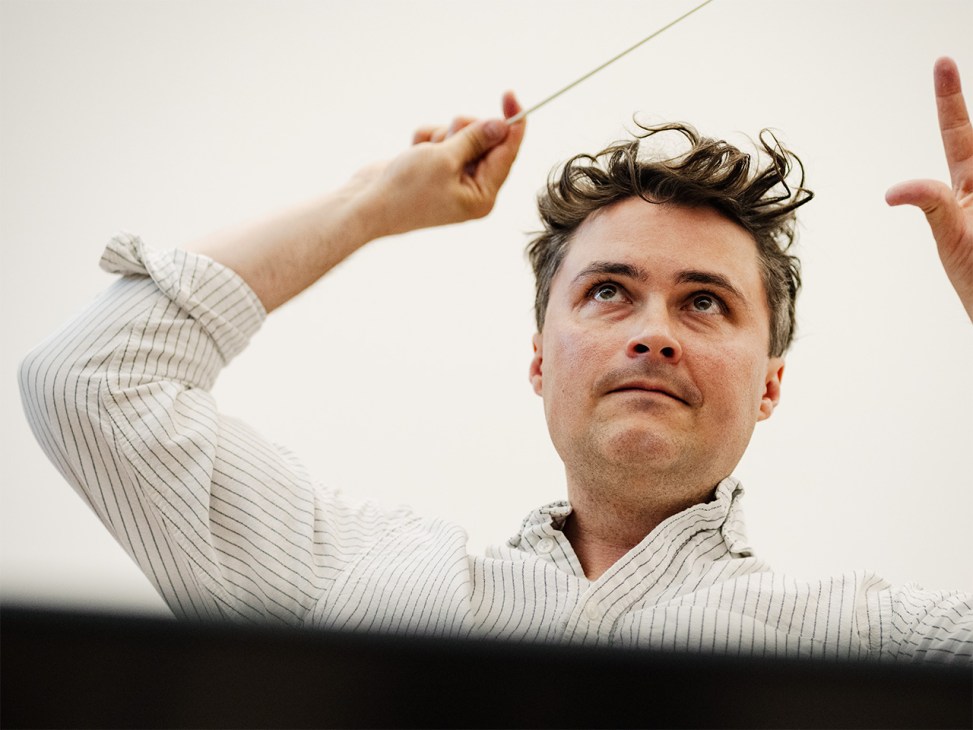
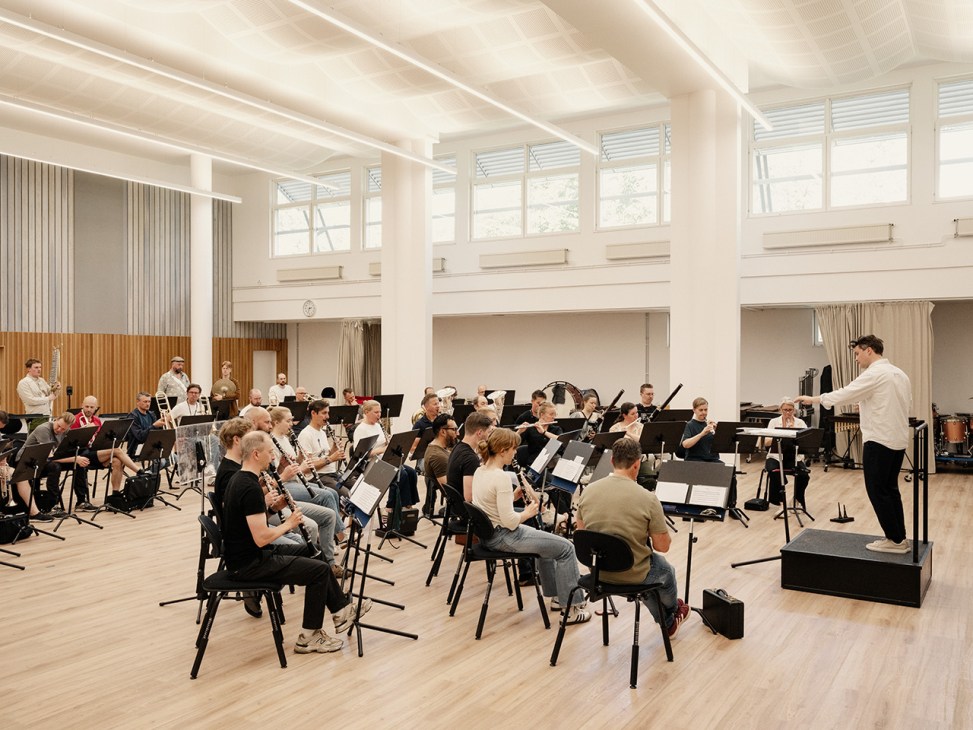
Most people recognise that pregnant pause as an orchestra readies itself to begin playing. But how many have then heard a 22-piece brass section toot out the opening notes of “Dancing Queen”? Monocle is on an industrial estate on the outskirts of Stockholm, watching the Swedish Army Band (SAB) conduct its final rehearsal before the next day’s Guldbröllop celebrations to mark the 50th wedding anniversary of King Carl XVI Gustaf and Queen Silvia.
The festivities, which are the largest of three events to mark this jubilee year, will include a flotilla around Stockholm Harbour, followed by a procession through the capital’s streets, for which the SAB will provide the main soundtrack. Abba’s 1976 mega-hit is on the setlist for good reason: aside from the fact that it’s the most famous song by Sweden’s biggest band, it was played live to the royal couple on the eve of their wedding. Symbolism matters, especially on days like tomorrow, and Abba encapsulates an image of modern Sweden as joyous, multilingual and ahead of the times. Though these characteristics still largely apply, the past few years have transformed this country, its monarchy and its armed forces – as well as their marching band.
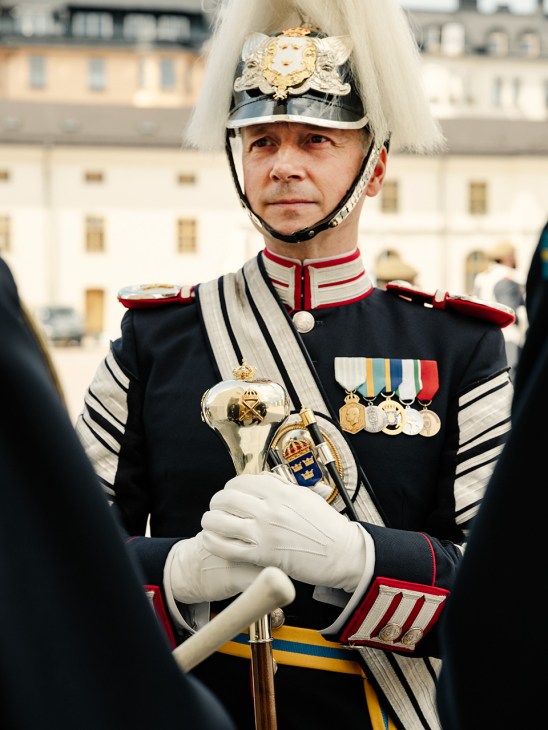


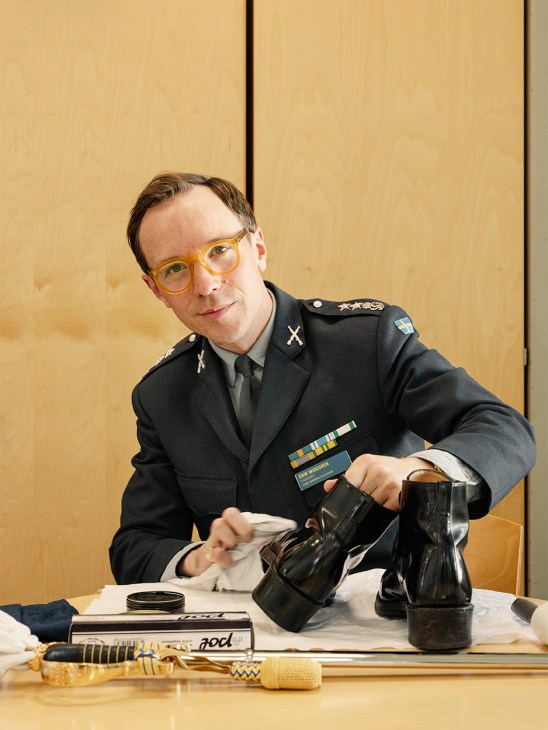
In 2024, more than 200 years since its last major war, Sweden joined Nato, ending a policy of official neutrality and committing itself to the defence of 31 other countries. As well as gaining membership of the world’s largest military alliance, the country has embarked on a huge rearmament programme in a rush to reverse decades of budget cuts and attract a new generation to its ranks. Lieutenant Erik Widegren, the SAB’s 39-year-old commander, is emblematic of this push. We meet Widegren in his office after rehearsals. Now the youngest commander in the band’s history, Widegren first became aware of the SAB at the age of 14, when it played at a fair in his hometown in southern Sweden. “I was drawn to the structure, the order, the level of commitment and the precision in everything that it did,” he says.
After finishing secondary school in 2006, he couldn’t decide whether to enlist or go to university. It was an inopportune time for a young Swede to be considering the former. “I talked to the army recruiters and they said, ‘You could have a good career with us but, at the moment, it looks like we might not have a job for you when you’re done studying,’” he says. Sweden’s 2004 Defence Act had codified a pivot away from territorial defence towards a military doctrine focused on peacekeeping and international crisis management. During the next decade or so, the country reduced its armed forces’ headcount by about 50 per cent, sold off barracks, bases and materiel, and abolished national service. So, Widegren accepted the offer of a place at the Stockholm School of Economics. After three years studying for a bachelor’s degree in retail management, he took up a position at US food giant Mondelez. Several promotions followed and, after a two-year stint in London, he found himself back in Stockholm contemplating his future. “I was talking to my wife and she asked me, ‘Didn’t you say that you wanted to be a military officer? What happened to that?’” he says. This was in 2019, when Sweden was beginning to reverse its military cutbacks, in part due to the increasing threat from Russia, which in 2014 had occupied Crimea. “A friend told me that you could become an army officer in just one year if you had a degree, because they were expanding so rapidly,” says Widegren. Most Swedish employers allow staff to take a year off to study, so he underwent officer training almost 20 years after he had first considered it.


It was a tough year but, at the end of it, Widegren decided to commit to the army, taking up a commission as a cadet in the Swedish Air Force’s Helicopter Wing. “I was 35 and had just taken a 70 per cent salary cut,” he says. A few months later, the command of the SAB – the unit that had so moved him as a 14-year-old – became vacant. “I wasn’t going to apply,” he says. “I had no command experience and my prospects didn’t look great.” The band’s commander usually has the rank of major, which typically requires a minimum of 10 years in the army. “But it was made clear to me that they would consider me for the role,” says Widegren. “They wanted leadership and people with outside experience who could change the culture.” He assumed command in January 2025.
The SAB traces its modern history back to 1982, when it was instituted as a conscript band, mostly for Swedes undertaking national service. It was professionalised in 2012, when the country abolished conscription. Today there are three professional bands in the Swedish Armed Forces (one for each branch) and 25 Home Guard volunteer outfits. The SAB employs 61 full-time musicians who, combined, play about 300 concerts a year. Recruitment is competitive. “We had an opening for a percussionist and about 26 people auditioned over two days,” says Widegren. “We chose one.” Tomas Lindberg is a 47-year-old percussionist who joined in 2011. “The biggest challenge for me was to change my grip on the snare,” says the drummer over lunch in the canteen. “You’re standing and moving, so it’s not straight – it’s at an angle.” Like many of his colleagues, Lindberg was a jobbing musician on the Stockholm orchestra scene before deciding to march to a more regular beat. “This is probably the most dependable job that you can have in orchestral music,” says the band’s 37-year-old musical director, Major Emil Eliasson.

The move to a fully professionalised troupe mirrored a shift in the band’s role. Before 2012, members would provide back-up combat support or medical assistance if required. Now they’re fully focused on performing. Flautist Caroline Walldén was sent to Afghanistan in 2013 to entertain the Swedish garrison in Mazar-e-Sharif. “We played typical Swedish music, which actually made the soldiers feel a bit homesick,” she says. The Ukraine war has affected not only Europe’s battlefield tactics but also its military bands. “After the full-scale invasion, the Ukrainians went from five professional bands to almost 60, just to be able to cover all of the ceremonies and funerals, and to boost morale,” says Widegren.
Between 2017 and 2018, Swedish defence spending fell to 1 per cent of GDP, its lowest since the Cold War. This year, it’s budgeted at about 2.8 per cent, a figure that the government has promised will rise to 3.5 per cent by 2030 to meet Nato commitments. More recruits are also being sought. A recent advert aimed at young women – the first for the Swedish army without soldiers, weapons or battlefields – shows one friend giving another a piggyback across a city bridge. “Marching with a heavy bag…” flashes an on-screen message. “You have what it takes.” Many of the troops lining up in the courtyard of the National Army Museum in Stockholm are conscripts. National service was reinstated in 2017 and Sweden’s Ministry of Defence is now targeting annual enlistment of about 10,000 conscripts by 2030, which would almost double the current intake. Nearby, patrons of the museum’s café are enjoying brunch in the sun. The contrast between the prosperous-looking, relaxed diners and the soldiers standing stiffly in gunmetal-grey dress uniforms is stark – but it also feels natural.
Because of its tradition of conscription, Sweden has always had a proportionately large army and the gap between it and civil society is not as great as it is in, for example, the UK, which has a centuries-old professional force. What has changed is an increased awareness of what Swedes are defending, at a time when the country has been engaged in some soul-searching. Since the late 2010s, Sweden has seen a surge in violent crime, mostly in poorer, immigrant communities. It peaked in 2022 with 391 shootings and 62 gun-related deaths – 2.5 times the EU average. A country that had for many years served as a role model for Europe and the world, particularly with its liberal stance on immigration, suddenly seemed like a basket case – a perception that was compounded by the electoral success of the far-right Sweden Democrats.
In some respects, Russia’s external threat has tempered national disquiet. “The army is marketing itself as defending freedom,” says Widegren. “That’s why we exist and they’re communicating that – you will see it on billboards all over town.” The defenders of that freedom have received a popularity boost too. In 2023 the Swedish Armed Forces were the top-ranked public agency in the country’s annual Confidence Barometer, with trust at an all-time high. The SOM Institute, a research organisation based at the University of Gothenburg, has found that 65 per cent of Swedes want to keep the monarchy, versus 11 per cent who favour an elected president. This might surprise those who see the country as inherently left-wing but the king and queen also seem to have benefited from geopolitical instability and political polarisation. “The king and the royal family are getting cool again,” says Widegren. “We’re so liberal in one way but we’re kind of coming back to those traditions and it’s unifying.” Like many of his European counterparts, King Carl XVI Gustaf has endured moments of scandal – indeed, the media, including Monocle, have had invitations to the post-parade palace party retracted thanks to the upcoming release of TV4’s Monarki, Sweden’s answer to The Crown, which dramatises several of the king’s alleged affairs. Yet his approval ratings are at a record high, while his heir, Crown Princess Victoria, was the most popular public figure in the SOM Institute’s 2023 poll.
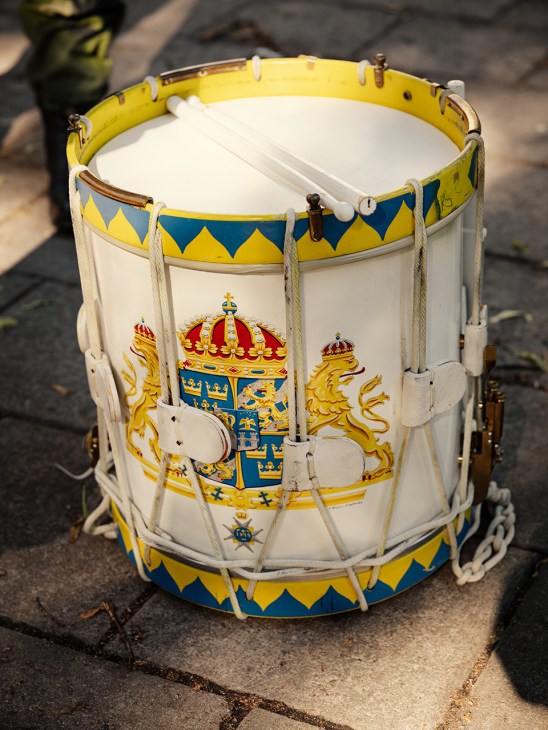
June’s ceremony is typically Swedish – orderly and low-key enough to avoid accusations of jingoism. After marching through central Stockholm, the SAB positions itself at a corner of Kungsträdgården. Here, it begins a 13-song set of traditional and modern Swedish tunes. As the king and queen’s carriage comes into view, the band launches into “Dancing Queen”. The gilded duo glide past with a white-gloved wave before disappearing towards the harbour. After the crowd’s whooping dies down, the band disperses for the beginning of its summer break. When it returns to full-time work in August, it will find itself once again beating the drums of war.

Swedish Army Band fact file
1982: The year that the band was founded.
2012: The year that it became fully professional.
61: The number of full-time musicians in the band (seven of whom are in the leadership team).
Most-played song: “Under Blågul Fana” (“Under the Blue-Yellow Flag”) is the band’s honour march.