‘Our main goal is to bring people out on the water.’ A bright new chapter for the iconic Danieli hotel
A subtle yet ambitious revamp has breathed new life into one of Venice's first grand hotels. Now under Four Seasons, its historic grandeur meets the lightness of the lagoon.
“When you come to Venice, it’s the landscape and the views that you’re after,” says Pierre-Yves Rochon, the Paris-and-Chicago-based architect behind the recent transformation of the city’s storied Danieli hotel. “I sat on the building’s roof terrace and saw the blues of the sky and the water, and the golds at sunset. I decided to bring them inside for guests.”
The Danieli, just steps from Piazza San Marco, has long embodied La Serenissima’s historical pomp and grandeur. When Four Seasons Hotels and Resorts announced its renovation in 2022, some fretted about the centuries-old landmark’s fate. They needn’t have worried. The grande dame has undergone a meticulous restoration in which baroque tropes (think dark interiors and heavy burgundy velvet) have been traded for the lightness of the city’s lagoon and sky.

“It’s still classical and still Venice,” says Rochon. “But it’s a fresher interpretation.” For the architect, a project of such scale and ambition is nothing new. He has worked with the Four Seasons group on flagship fit-outs in Florence, Paris and Milan – but this project is particularly notable for the way that it captures a sense of place.
The Danieli’s guest rooms reflect the painterly palette that inspired the old masters: soft pastel satins, pale wood and watery blues. It’s the Venice of Canaletto transformed into light-filled spaces and sky-coloured furnishings. The city’s time-honoured crafts are key to the details, such as the classic damasks that line the walls, woven by Venetian firm Rubelli.
The canals and the old structure of the Danieli’s palazzo added to the restoration’s complexity. Just as visitors to Venice get around by boat, every mattress, reupholstered chair and air-conditioning duct for the hotel had to be transported by water, with pieces lifted through the gothic window frames by a floating crane. That’s one reason why the renovation took three years to complete.


The gothic Palazzo Dandolo was completed at the end of the 15th century as the home of a family that gave Venice several doges. In 1822, Italian entrepreneur Giuseppe Dal Niel converted it into the Danieli (the local pronunciation of his name), creating one of Venice’s first grand hotels. At the heart of the city, just one bridge from the Doge’s Palace, the Danieli later expanded into two neighbouring palazzos from the 19th and 20th centuries. Its lavish interiors and prime position drew guests including Johann Wolfgang von Goethe, Lord Byron, Marcel Proust, Greta Garbo and Grace Kelly. But by the time Four Seasons took the tiller, its lustre had faded.
Entering the waterfront lobby today feels like stepping into another era. The concierge’s dark desk welcomes guests with a wall of brass keys. The reception opens onto the palatial lounge of Bar Dandolo, with its vast, stained-glass windows, Corinthian columns, rainbow-tinged Murano-glass chandeliers and soaring ceiling of gilded quatrefoils. When Monocle visits, a few craftspeople are busy applying the final sheaves of gold leaf. The lobby is awash with watery reflections of the lagoon that filter in through the stained glass. We peek into the elevators, which are still under construction, and see their doors of etched antique mirrors and gilded frames receiving a final buff.


“I love working in Italy,” says Rochon. “There are artisans for terrazzo, for marble, for mirrors – for everything.” Sunlight streams in through the glass atrium, illuminating the thick-carpeted stairway at the hotel’s heart. Upstairs, workers unwrap chairs and straighten the portraits of grave, long-dead doges that hang in the suites.
“When you book a room here, you’ll have expectations,” says Christian Zandonella, the Danieli’s general manager. “We wanted to update the hotel, respecting its history without being too vintage. It had to be timeless because people have fond memories of this place.”
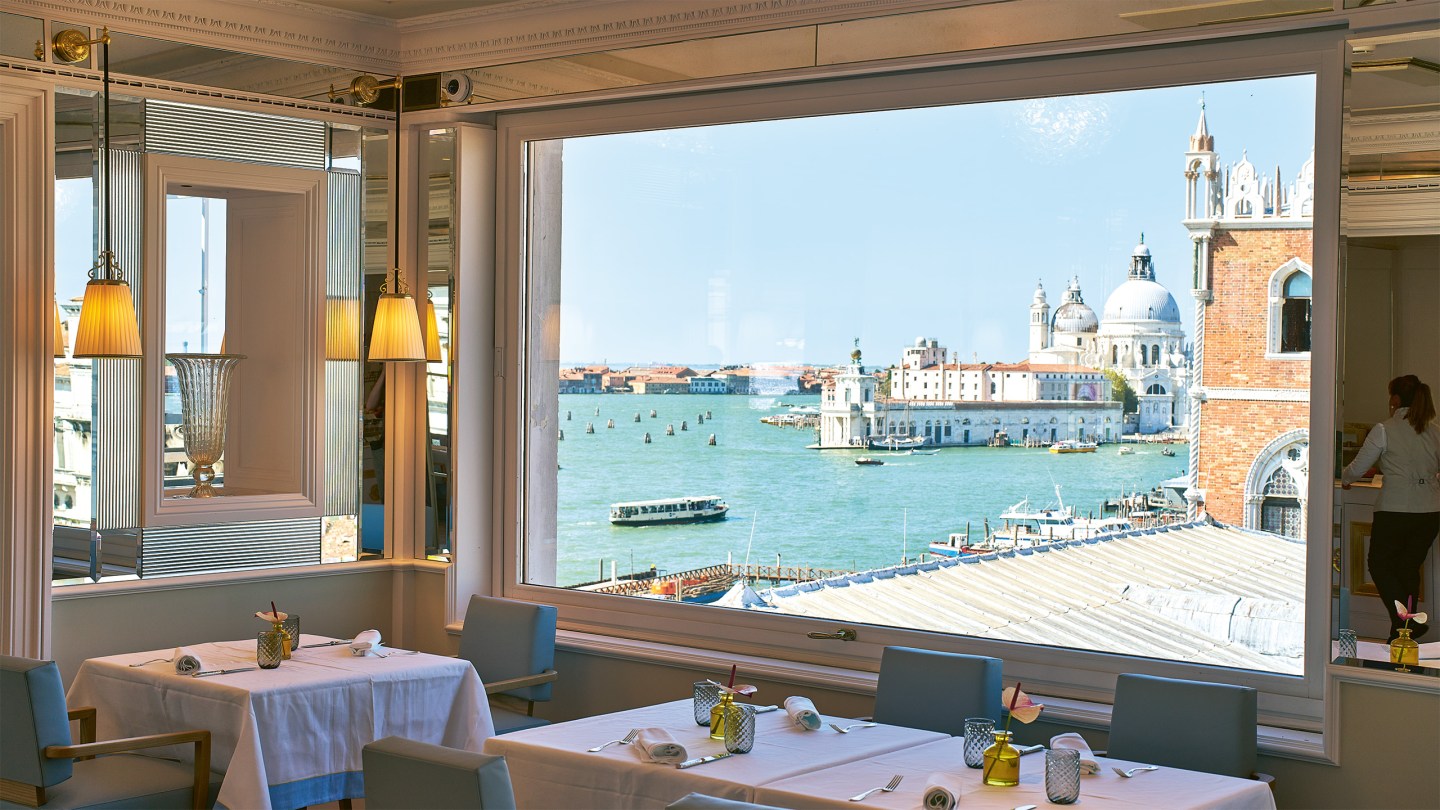
Nostalgia, however, hasn’t prevented Rochon from significantly reimagining the top-floor restaurant, Terrazza Danieli. The once-sombre space has been recast with soft blues, large mirrors and picture windows facing Piazza San Marco. “Now the dining room is part of the skyline,” says Zandonella.

Five storeys up, the terrace offers views across the Grand Canal towards the Bacino di San Marco and Punta della Dogana, with the islands of San Giorgio and Giudecca just beyond. Rome-born Adriano Rausa, who previously cooked with celebrated Sicilian chef Ciccio Sultano, is in charge of the restaurant and brings a southern Italian flavour to Venetian classics. Rausa says that his research involved dining at trattorias that were popular with locals “in search of authentic flavours”. (A tough gig.) “Venice has always been a place of cultural cross-currents, where new foods and flavours mingle with local recipes,” the chef tells Monocle. “Cooking connects so many different influences and turns them into something joyful.” His kitchen draws on close relationships with the city’s fishermen and the island farms of Sant’Erasmo; expect Venetian-style tuna belly, crab tortelli and a hearty Adriatic seafood stew.
There’s more to come too. Later this year a full spa and canal-facing sauna will open at the Danieli, as well as an indoor pool (the first in Venice’s centre). The hotel’s 1950 Excelsior palazzo, meanwhile, is scheduled to reopen in 2027, with garden suites and dozens of new guest rooms, bringing the total to 168.
Despite the time and effort spent on getting the building right, everyone who Monocle meets here seems transfixed on the lagoon outside. “Our main goal is to bring people out on the water,” says Zandonella, referring to a fleet of boats in the works that includes a traditional fishermen’s dinghy, a restored houseboat and an electric gondola. New itineraries will involve trips that venture beyond the main island to Torcello and Pellestrina, with guests stopping at generations-old trattorias, joining fishermen for lunch or heading to the sandbars with an ecologist to explore the lagoon’s wildlife. Striking architecture is one thing but, in Venice, it’s only ever part of the equation. “Our life is on the water,” says Zandonella.
Tips for lagoon living:
- Learn to row like a Venetian at Associazione Remiera Vogaepara on Burano, where crews stand and paddle in unison.
- Venice’s salt marshes (le barene) are known for their tidal pools and rich ecosystem of aquatic and bird life.
- Pellestrina, the slender island separating Venice from the open sea, retains its old fishing villages where women still make lace.
- Locanda Cipriani hotel reopened this summer on the quiet and remote island of Torcello, following a restyling of its restaurant and rooms.
- Giudecca, the most residential of Venice’s islands, is drawing new attention while remaining resolutely local, with seafood restaurants such as Altanella.