Issues
Germany has been lulled into a false sense of security. It must rearm
Germany needs to rearm – but it’s easy to understand our aversion to the idea. We have to explain to people that if they want to live in a free and peaceful Europe, we need a strong military so that nobody thinks about attacking us.
Germany’s current aversion to defence comes from our history. During the 20th century our country was responsible for two huge global conflicts. It has been vital for us as a society to reckon with the past. That was the reason why the Allies dissolved the Wehrmacht, and everything military-related, in Germany after the Second World War ended. But our current predicament is dictated by more recent history. Germany rearmed by the 1950s as the Cold War intensified. In 1955 the Bundeswehr (Armed Forces) was founded and what was then West Germany became a member of Nato. After the Berlin Wall was built in 1961, the Bundeswehr grew. Germany already had conscription in place and by the end of the 1960s there were about half a million soldiers under arms. In 1964, Germany spent nearly five per cent of its gdp on protecting itself. At the end of the 1980s, the German defence budget was nearly €60bn.
So what happened? The wall came down and, with it, the main threat disappeared overnight. Since the 1990s the number of soldiers under arms has dropped. Today our active-duty army stands at about 180,000 soldiers; we paused conscription in 2011. Germany militarised with the construction of the Berlin Wall and de-militarised when it came down. Now that paradigm needs to be rethought.
Germany, like other European countries, has been lulled into a false sense of security. This was true in the Germany I remember when I was growing up. Many thought that the Cold War was over and the paradise we had been longing for had arrived. There was no place in our collective imagination for the idea that the situation could change and war could return to our continent.
Even if the majority of the Germans alive today weren’t even born at the time, our commitment to peace remains our collective responsibility. An anti-military sentiment has been passed down through generations. Our history means that the military isn’t a popular topic. Whenever previous governments since 1990 needed money, they looked to take it out of the defence budget – and many people didn’t care.
That’s why our Armed Forces are run down today. In 2022, an investigation revealed that Germany only had ammunition to last a few days at war; defence minister Boris Pistorius said that there wasn’t enough money put into the military in the draft 2025 budget. The legacy of the Second World War, the fear that one day Germany might be responsible for another war, has left many people paralysed, afraid to make important defence-related decisions.
The very countries we attacked 80 years ago don’t suffer from the same issues. The best example is Poland. Many friends there now say that they are more afraid of Germany being too weak than too strong. Instead, they’re waiting for Germany to lead Europe’s military recuperation and counter Russia’s aggression. As Europe’s largest economy, it makes sense that Germany should play this role. We have rebuilt trust since the end of the Second World War. But it is also a strange position to be in. Everyone around us seems to believe in us but we still don’t trust ourselves.

So when Russia annexed Ukraine’s Crimean peninsula in 2014 and launched a full-scale invasion in 2022, it took Germany time to wake up. But full-blown conflict did prove enough to stir us from our slumber. If you compare the state of our army currently to how it was just a few years ago, we have achieved a lot. A key moment was chancellor Olaf Scholz’s “Zeitenwende” speech on 27 February 2022, three days after Russia invaded Ukraine. He promised a historic turning point in Germany’s defence policy. A €100bn fund was created by finance minister Christian Lindner to increase military spending and we began to send weapons to Ukraine. But, despite this, the situation is incomparable to our army’s strength before the 1990s.
When I started studying political science at university, I had a conversation with a professor. We were focusing on Japan and its territorial dispute with Russia over the Kuril Islands, just above Hokkaido, that have been occupied by Russian troops since 1945. It had been framed as a frozen conflict and we were questioning whether it really is possible to “freeze” a dispute. At the time we were all in disagreement. But I know that if I was having the same conversation now, my answer would be a definitive “no.” It might be the best way to handle a problem for politicians in the moment – pressing pause on an issue and seeing what happens next. But when I was in Japan in March 2023, I met the defence minister and encountered the same questions that I had discussed nearly 45 years earlier as a student. It’s no use freezing a problem and handing it down from one generation to the next. We must solve issues here and now.
Germany’s most recognisable recent leader, Angela Merkel, became infamous for freezing conflicts. When Russia grabbed Ukrainian territory in 2014, instead of leading other European countries in a strong response, Merkel dithered and hid behind the excuse that other European countries had to be consulted. But the hypocrisy couldn’t be more obvious; when it came to taking decisions such as striking a deal with Vladimir Putin over cheap Russian gas through Nord Stream 2, Merkel acted alone and against the interest of our European partners. In the end, the 2014 Minsk agreements suspended Russia’s attack on Ukraine for a little while – and we all know how that turned out. Merkel’s foreign policy was a total failure. She never explained that military problems could arise for Germany as a result of Russia’s actions. Instead, she promised something ambitious yet vague. In fact, her re-election slogan was, “Für ein Deutschland, in dem wir gut und gerne leben.” (For a Germany in which we can live well and like to live.)
Today’s politicians need to be clear with the German public: the situation has changed since the 1990s and will do so again. It’s natural that citizens are more preoccupied with everyday economic issues and their children’s prospects than defence spending. But a government’s job is to explain the risks and demonstrate how they are managing them. With its invasion of Ukraine, Russia has shaken the rules-based international order, which is the foundation of all international relations. That Russia would actually send troops into Ukraine was inconceivable for many before it happened. If Ukraine loses this war, there isn’t only the danger of Putin showing up on our borders next. There’s also the danger of a copycat effect. China might decide to force Taiwan under its control; Iran has already attacked Israel; Serbia might decide that Kosovo has been independent long enough. If the rules-based international order collapses, peace and freedom are at risk. The mere idea of the EU as a civil power would become obsolete.
There is no doubt that we have the chance to live in a positive future. But for that to happen, Germany has to get rid of the fear rooted in our history and show real leadership. Putin knows that most Germans will want to block out terrible stories of war and focus on improving their own lives (“living well”, as Merkel called it). Let’s not forget that Putin lived in Germany, speaks our language and understands our mentality well. But voters here have a choice.
Becoming tolerant of food intolerances is knowing that it’s none of your business
It’s pretty rare, as a restaurant critic, that I become immersed in the niceties of theological debate – but that’s the rabbit hole in which I found myself recently. At an Anglican Eucharist service in Cambridge, I heard the priest issue a warning from the pulpit that anyone intolerant to gluten should not step forward to receive the host.
Some of the greatest schisms in the church have developed around the complexities of transubstantiation – whether, at what point and how the blessed bread and wine transform into the actual body and blood of Christ. There is a gigantic quantity of writing about the practical details. I willingly plunged in to find out.

The Church teaches that to be valid, the Eucharist “must be offered with bread and with wine in which a little water must be mixed”. The Code of Canon Law specifies that bread “must be only wheat, and recently made so that there is no danger of spoiling”. So can you have a “gluten-free host”? Not if it’s made solely from wheat, as prescribed. And so, faced with the awful possibility of having to opine on whether the flesh of the son of God, at the point of transubstantiation, is fully gluten-free, Canon Law has stuck with the marginally less controversial ruling that coeliacs shouldn’t take communion. My point? If you think religious law is confused, take a look at the hospitality sector.
As well as writing about food, I run a café and bakery. In common with many of my colleagues in the hospitality industry, we handled the food-intolerance issue badly at first. We were baffled, incredulous and often angry when a vast surge of allergies and sensitivities presented themselves in our dining rooms. When the hell did everyone start thinking that a bakery was a good place to expect gluten-free food? Nut allergies and anaphylaxis, we could handle, we were trained. Besides, we reasoned to ourselves, people with EpiPens had always known how to handle themselves. But this new stuff was uncharted territory.
And then the law changed. Governments across Europe began legislating for product labelling and new service behaviours across the food industry to meet the problem. The costs of complying were astronomical, the cost of failure unimaginable. For a while, the genuine rage in the industry was palpable. We knew that allergies were a serious issue; they always had been. But now law was being written pandering to the worried, the neurotic and the self-diagnosers. Ask any front-of-house staff and even today they’ll have 100 war stories of customers ordering an egg-white omelette “with no egg” or finishing a diligently prepared gluten-free meal by spontaneously diving into the chocolate cake. And it’s not just a few tales retold; every single person working in hospitality had regular experience of customers “crying wolf”. Then things changed again.
It’s difficult to pinpoint any exact moment. Certainly, as the numbers increased, everyone knew people with intolerances or allergies personally. Allergies and intolerances affected everyone. In supermarkets and food manufacturing, the changes in labelling progressed. You couldn’t miss the aisles of “free-from” food and the increasingly detailed labels wherever you shopped. But hospitality required more nuanced changes in attitudes and behaviour.
Today, the question arrives right at the top of the order of service: “Does anyone at the table have any allergies we should know about? Let me get you some menus.” Your preferences are carefully noted and acted on. Restaurants now talk about “dietaries” in the same way they talk about wine preferences or whether a customer is a decent tipper. There’s no more judgement of an individual customer avoiding hot spices or members of the nightshade family than there would be of avoiding peanuts or pork. We’re geared up for it now, and whether your preference reflects millennia of your culture or something you heard last week from a very thin person on Tiktok – be it a diagnosed medical condition or a complete whim – it’s nobody’s damn business but yours as an individual.
Is this a sign that the hospitality industry has grown up a bit? Well, yes, but customers have changed too. High-maintenance punters still delight in giving staff the run-around with complicated requirements but there have always been people like that. Before they realised that they could request “nothing red on the plate”, they would have been complaining about the noise of the air-conditioning, the proximity of the bathroom or deploring the placement of a side plate. They’ll always be with us. Meanwhile, the eternally fretful “picky eaters” have moved on to part-time veganism, fear of carbohydrates or plant-based dietary demands. There’s still a long way to go but, importantly, a more mutual trust has grown and people with genuine allergies or intolerances are beginning to feel heard.
Perhaps the best indicator of this is the presence on menus, along with a slew of “free-from” options, of the ubiquitous quiet announcement, “While we try to ensure that our products are made without allergens, they may be used in our kitchens. Please ask your server for details.” This isn’t a disclaimer; it’s a discreet invitation to talk. You want to see exactly what allergens are in every dish on the menu, sure. We have a stack of spreadsheets as thick as a loaf of bread. But we can sort this out a lot more comfortably with a 30-second chat, at the end of which everyone feels heard, understood and, above all, safe.
There’s a model in psychoanalytic theory called Transactional Analysis, which posits that both sides in a relationship will occupy one of the three “ego states”: parent, adult or child. If one participant acts like a child, the other is inclined to, or sometimes forced into, acting like a parent, and vice versa. In therapy, the aim is to achieve a simple equilibrium, a grown-up state where I, as an adult, speak to you, also an adult.
For a long time, the hospitality industry, shocked by the pace and manner of change, behaved like children, refusing to take responsibility for the food we served, forcing the customers to do all the grown-up thinking. Sometimes, customers behaved like children, expecting the industry to cater automatically to their every imagined need, forcing us to take control and responsibility.
Today it feels as though we might finally be communicating, talking about a shared responsibility like adults. It’s a more relaxed and hospitable state of affairs. We care about you as guests; you trust us as hosts. It’s how it was always supposed to be. And that should have our blessings.
About the writer:
Hayward is an award-winning British writer, broadcaster, restaurateur and “unrepentant food geek”. His latest book, Steak: The Whole Story, was published in 2024 by Quadrille.
The first spy I ever met fooled me completely – because she was female
In the early 2000s, after a career as a journalist and editor, I had been offered a job working for the British government as a counter-terrorism communications consultant. It was, in some ways, the traditional tap on the shoulder – an old colleague approached me directly, asking if I would be interested in the work. I found the offer too intriguing to turn down. My job was to explain to people what intelligence agencies were doing and how they worked; to get past the Hollywood myths and make spies real.
Before I could start, I had to get security clearance. This was a mysterious process in which I answered about a dozen questions and then everything went quiet for weeks until my government pass arrived. I was in – or so I thought. But once I was through the secure glass doors of the Westminster office, I had very little to do. Nobody said anything but I got the impression that they were waiting for something.
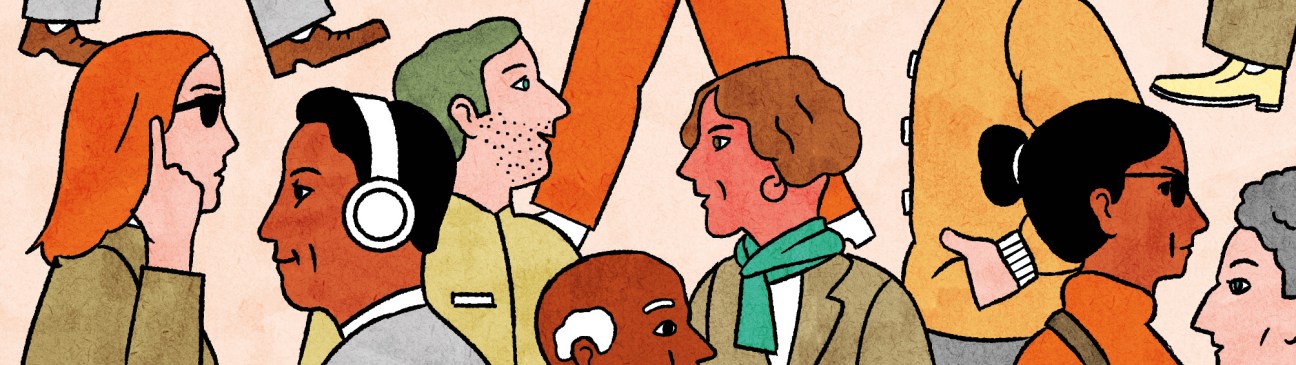
It was then that I was befriended by a young woman. She was about 28 years old, with wide blue eyes. She said that she had just started working in the legal department. We had a brief conversation while making tea one afternoon. I didn’t think about her again until a few days later, when I ran into her on my bus after work. We sat together during the journey and decided to go for a coffee the next day.
Over the next few weeks, we often had lunch together. She asked about my family and background. I’m a sharer and I chatted away happily, right up until the moment she disappeared. And I mean she really disappeared: her phone number, her email address… everything was gone. When I asked around the office, nobody could remember her. It was as though I had met a ghost.
Almost immediately though, things changed for me. I was invited to meetings that had been closed to me before. My work began in earnest. And gradually I realised that the friendly blue-eyed office worker had been a spy. She was the last step in my background check. Of course, I’d known from the start that I would be working with spies – that was the point – but I had never suspected that she might be one. This was because fiction had never shown me a spy like her.
What little we know about spies we learn from books and films. In fact, most of what we believe comes from just two writers: Ian Fleming, who created the Bond fantasy of the dashing, charming, Etonian spy; and John le Carré, who brought us the realpolitik of bitter, jaded men in rumpled suits and unheated offices, undermining each other while duelling with Soviet agents.
There have been other successful spy novelists, of course, but our collective vision of spies still largely comes from the work of those two British men and, to a lesser extent, the books of Len Deighton and Graham Greene. Their novels form the accepted canon of the genre against which all modern spy novels are still judged. And yet all those authors failed to write believable women characters.
Fleming’s women were blow-up sex dolls with ludicrous names such as Pussy Galore and Holly Goodhead. The women in Le Carré novels were absurd in a different way, presented as either the “mothers” – his word for secretaries in mi6 offices – or Connie Sachs, an ageing, sex-mad alcoholic. Aside from an occasional minor character or traitorous wife, we don’t see other women in the books lauded as the greatest spy novels. They simply aren’t there.
I believe this is why I am constantly asked whether there really are female spies like the ones I write into my novels – normal women doing extraordinary jobs. Over and over again, I tell people they exist. I explain that the actual Q (the technical genius in the Bond novels whose job exists in real life) is a woman. And that three of the four current division heads at mi6 are female. I can’t blame them for being surprised. After all, I was surprised to meet so many women spies.
Naturally, mi6 is aware of this. Recently, it has been recruiting more women, and one of the biggest blocks it finds is that women don’t realise they could be good at spying or that they would be welcome in intelligence. One advertisement that the service ran a few years ago showed a mother with a small child and the words, “Secretly, we’re just like you.” And they are. The women I met during those years were of all backgrounds and classes. Some were approachable and open, others incredibly intimidating and formidable. I met a lot of male spies too, of course, but the scariest spy I ever met was a woman.
She had a freezing stare that seemed to stab into the most shallow and insignificant parts of my soul. I was certain she could see all my faults through my skin. She was in her sixties, weathered and disdainful. I might never have met her, but she was invited to a meeting about a major forthcoming event. Everyone else in the room – all male intelligence officers – deferred to her. She was, I suspect, the most senior person I met in intelligence during my career, although her rank was never revealed to me. All I knew for certain was that she had no time for someone like me telling her that spies should talk publicly about their work. I’m not easily intimidated but in that meeting I found myself fumbling my words and saying inane things. I couldn’t wait to get out of the room.
She was entirely different from the first female spy I encountered. In that case, it was her sheer ordinariness that made me never question her. She was so normal in her brown skirt and slightly scuffed boots, with her hair pulled back. She had a vicious sense of humour and was so convincing that I believed everything she told me. And yet every word she said was a lie. I’ve wondered for years how she could have been so smoothly deceptive at such a young age.
If I had known my history then I wouldn’t have been surprised. Female spies, especially young women, have been critical to intelligence for decades. Consider Nancy Wake, nicknamed “White Mouse” by the Germans during the Second World War. Wake was a British spy who joined the French Resistance aged 29. Working first as a courier and then as a member of the Escape Network, she helped numerous Allied airmen slip out of occupied France to safety in Spain. After fleeing France in 1943, she later parachuted back in to help British intelligence organise French guerilla groups. She was never captured and died in 2011 at the ripe old age of 98.
Then there was Virginia Hall, an American socialite who lost a leg in a hunting accident before the Second World War but still travelled to France to offer her services to the Resistance. Fiercely intelligent and utterly without fear, she eluded the Nazis throughout the war, carrying critical messages for British intelligence and uniting rebel groups, running operations that changed history. The Germans knew her only as die hinkende Frau (“the limping woman”). She became their most wanted Allied spy but was never caught.
Authors Ian Fleming and Graham Greene both served in intelligence alongside Virginia Hall during the war. They would have known about her and Nancy Wake, and the other female spies who risked – and often lost – their lives. Even though he came into the firm later, a scholar such as Le Carré would certainly have heard of them.
They knew about these female spies. Some even met them. And then they wrote those women out of their books. It was so consistent across all the male espionage writers that it couldn’t be an accident. But why would men who knew about these fascinating women choose not to represent them in novels about spies? Of course, we will never know the full truth, but I believe it was fear.
Consider that Graham Greene was born in 1904; Ian Fleming in 1908; Len Deighton in 1929; John le Carré in 1931. They lived at a time when women were in no way equal, for most of their lives unable to buy a home without a man’s permission and unable to have a bank account of their own. Often they were fired as soon as they were married. Then the war came along and everything changed.
Everyone was needed and it turned out that, among many other things, women were very good at spying. How intimidating that must have been for someone like Fleming, a writer with minimal ambition who got a job in intelligence thanks to his mother’s connections. Imagine him in a room with Virginia Hall. She must have had an icy stare like that older female spy I once met. Ruthless, brilliant, unforgiving.
When Fleming and his generation penned their novels years later, the women they wrote weren’t brave or intelligent. They were sex toys or traitors. Because these writers had worked in intelligence, people assumed they wrote what they knew. But they didn’t; they wrote what they wanted us to believe. But there’s an oddly positive twist. By ensuring nobody knew that female spies existed, those authors unintentionally made life considerably easier for the women who really hold those jobs. Yes, it’s galling to be written out of fiction but if people don’t know you exist, they never see you coming. You can slip in and out of their lives unnoticed. Like a ghost. And that’s the best gift you could give a spy.
About the author:
Glass is the CWA Dagger-shortlisted author of spy novels The Chase, The Traitor and The Trap. A former crime reporter and communications consultant, she worked closely with spies for five years and they inspire every book that she writes.
Cities are bad for us. Here’s how to fix them
Like many Danes of my generation, much of my childhood was spent immersed in the world of Lego. The “City” universe was my absolute favourite. I got to play the role of urban god, carefully piecing together my dream metropolis from the ground up. I had a fire station and an assortment of other buildings but most of my constructions came from my imagination. Gardens were essential, with tiny flowers and soft plastic trees filling the spaces between my buildings. Even back then, I was obsessed with trees – both in my Lego world and the real one.
What I didn’t realise at the time was how much the layout of my pretend city – like so many real ones – was governed by roads. The foundation was always a grid of grey plates directing the flow of traffic and determining how everything else would fit together. If the roads didn’t connect seamlessly, the city simply wouldn’t work. They dictated everything. That’s how I formed my earliest, unconscious definition of a “real city”.
A few decades have passed since then and I now spend most of my time, in my work as an urban designer, rethinking and challenging what a real city could and should be. Despite all the energy and creativity they hold, urban environments are also responsible for making us sick. They pollute the air with heavy metals, trap heat in concrete jungles and surround us with so much noise that our brains and hearts struggle to find peace. Despite being home to much of the world’s population, cities often isolate us more than they connect us.
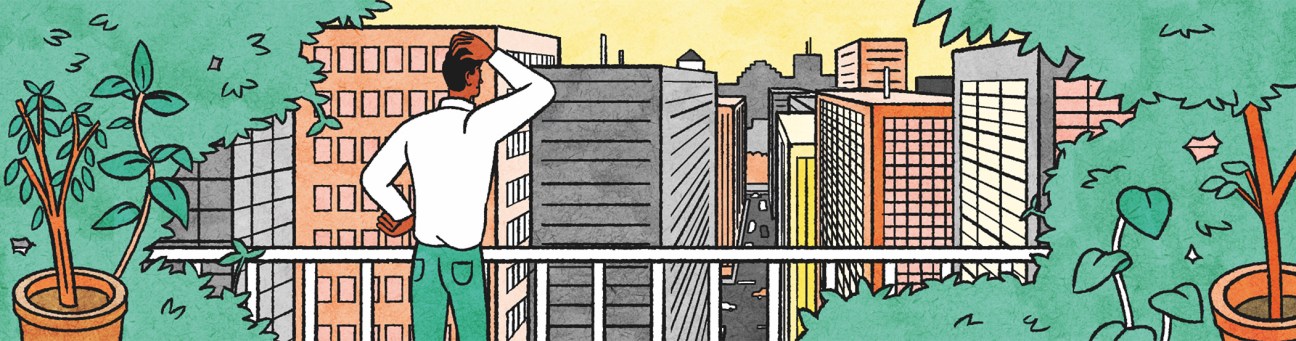
Let me be clear about one thing: I love cities. I grew up in Copenhagen, and today I live in the heart of the city with my family, right next to a busy road. I thrive on the energy that cities provide – the inspiration, the communities, the culture and the innovation. Cities are where ideas take root and where diverse people come together to create something greater than the sum of their parts. I want my children to experience this richness of life, which is why we’ve chosen to stay in the urban core. But there are aspects I don’t love: the unrelenting traffic just outside our door and the sheer amount of space dominated by black asphalt, covering about 80 per cent of the public area between buildings where I live.
That’s why I began to construct my own little slice of urban life – my garden. When we bought the house, this garden seemed like no more than a parking space. But slowly it evolved into a green oasis. My goal was to create a haven for my family; a place where we could escape the noise and heat of the city. We planted as many trees as we could afford, transforming the area into a biodiversity hub, providing shade, lowering temperatures and absorbing rainwater. More importantly, we created a sanctuary filled with birds whose songs drown out the cacophony of urban life (city birds sing louder than their rural counterparts; nature’s own way of adapting to urban noise). Our garden isn’t just about greenery, though. We also installed a noise-reducing fence made from poplar bark, a sustainable by-product of the furniture industry. The bark absorbs airborne pollutants from car exhausts, which improves air quality around our home and provides a natural, tactile material that passers-by can’t help but touch.
The poplar fence panels came from an exhibition by sla – the studio where I’m design principal – at Copenhagen’s Louisiana Museum of Modern Art. Our exhibition focused on the power of trees and nature in cities. Our fence, like trees, represents a small but effective act of resistance against the problems that urban life can create. Noise pollution, in particular, is a silent killer. It causes stress, disturbs our sleep and contributes to chronic health issues. The simple act of planting trees and installing noise-reducing materials can transform a space and dramatically improve our quality of life. Cities should not be places where we merely survive; they should be places that we truly love.
At the heart of all my work is a desire to improve quality of life – for all life. Our team includes biologists, architects, landscape architects, planners, lighting designers and anthropologists, working together to design cities that don’t just look beautiful but function in a way that makes life better for everyone. We’re also challenging the traditional hierarchy of cities, where roads and cars have always taken precedence. We’re not advocating for their removal but we believe that it’s time they stop ruling the urban landscape. City design needs to change urgently.
One of the most eye-opening experiences I’ve had was working closely with indigenous designers in Canada, whose traditional knowledge, stretching back thousands of years, offers an invaluable perspective. Their principle of considering how every decision will affect the next seven generations forces us to think beyond the short-termism that dominates most modern urban planning. How many recent developments in the city where you live have been designed for two generations after you, let alone seven?
One specific conversation with an indigenous designer left a lasting impression. We were discussing the rather technical term “storm-water management” when he interrupted to suggest we just call it “rain” or “the flow of water that falls from the sky”. This simple reframing, from technical to nature-based, shifted my perspective. Everything in nature is about flow, he reminded me: wind, water, energy, even people. Yet for the past century or so our cities have been built to disrupt these flows. This is why Copenhagen was hit so hard by flooding in 2011 (my own basement was one of thousands filled with water). And now even desert cities such as Dubai, which once laughed off our rainwater-management proposals, are asking for help as they face big water challenges of their own.
Unfortunately, meaningful change in cities only seems to happen when insurance companies and municipalities are forced to act after suffering massive financial losses. But you can’t put a price tag on quality of life. Feeling safe, connected and good are invaluable concepts. Cities should be designed to provide them.
Planting trees is perhaps the simplest and most effective way to improve urban life. Trees change not only the physical environment but also the way people feel and behave in public spaces. Think about where you would rather spend your day – in a park under a tree or in an asphalt car park under a lamppost? Nature has been proven to lower stress levels, make people feel more at ease and encourage social interaction. When we feel connected to nature, we feel more connected to ourselves and to others.
My best memory of this is our collaboration with 1,500 Copenhagen students, helping them to transform their 1960s concrete outdoor space into a social and biological corridor. The composition of their dorm was changed to include 10 per cent set aside for socially disadvantaged individuals. The students took clear social responsibility by inviting their less fortunate peers into their home. They intuitively understood the connection between biological diversity and social equity.
The path forward may be challenging but it’s exciting. We can change the way cities are built and experienced. As someone who started life literally playing with the concept of how a city should look, I now find myself working on how to grow them, for us and for future generations. Cities are often bad for us – but it doesn’t have to be that way.
About the writer:
Astrup is partner and design principal at Danish studio sla, specialising in city nature, sustainable landscape architecture and integrated climate adaptation. He spoke at The Monocle Quality of Life Conference in Istanbul in 2024.
How to stage an art heist
In many ways, a contemporary art gallery has a lot in common with a courtroom. Both are places of high spectacle, of lofty judgement, enforced decorum and politesse. People dress up to attend both and often leave owing vast sums of money (possibly overcast with fear or shame). It has always seemed odd to me, therefore, that when art dealers end up on trial, they do such a good job of looking out of place, of seeming shocked to be there. A good blue suit, it seems, will only get you so far.
Art dealers are synonymous in the public imagination with big money and dastardly behaviour. (I once briefly dated a woman whose family beseeched her to break up with me solely because I owned an art gallery.) And so, when considering how to pull off a fine-art swindle, it can be a little difficult to choose from the bright and varied palette of available criminality. Cicero wrote, “To be ignorant of what came before you is to remain forever a child.” Fortunately, the history of art-market criminality provides us with plenty of lessons in deception and scurrility.

When I tell people that I’ve recently published a book about fraud in the art market, their questions tend to go straight to art forgery. They picture a little old man in a remote Tuscan village, painstakingly putting the finishing touches on an as yet “undiscovered” Leonardo. This new-old painting then makes its way to market via a network of beret-wearing scallywags, all of whom smoke ominously and from the sides of their mouths, despite the conflagratory risk to their precious cargo.
This image comes, of course, from Patricia Highsmith novels and Hollywood movies starring hirsute billionaires, but it does have roots. One such forger (Dutch rather than Italian) was Han van Meegeren, the most prolific and successful forger of Vermeer paintings. Van Meegeren was canny in his choice: not only were Vermeer paintings incredibly valuable and sought-after but there were also very few of them (there are probably only 35 in existence). The discovery of “new” works by the Dutch master was welcome news to gullible buyers. Working from the basement of his house on the French Riviera, Van Meegeren used Bakelite to form an authentic-looking craquelure on his paintings.
Van Meegeren is remembered in the Netherlands as something of a national hero. During the Second World War, Hermann Göring traded 137 looted Dutch paintings for just one of Van Meegeren’s fake Vermeers. Van Meegeren thereby helped to safeguard precious national heritage – and got one over on the Nazis. After making and selling more than a dozen fakes (and becoming hugely wealthy in the process), Van Meegeren was caught and put on trial. He died in 1947, months into his prison sentence, at the age of 58.
What Van Meegeren did right was to select an artist to forge whose work was scarce. Half a century later, however, Iranian-American Ely Sakhai pulled off a fraud scheme with a brazenness that employed the opposite approach. Sakhai, who speaks fluent Japanese, knew that what most concerned new collectors in Japan was authenticity. So he trawled the auction houses of Europe and America, exclusively buying minor works by major impressionist artists, from Monet to Renoir, that came with certificates of authenticity. He would then have the painting expertly copied and sell the facsimile, along with its original’s certificate, to a Japanese collector. This went on until one of the buyers decided to sell, and a sharp-eyed auction-house employee in New York spotted what appeared to be the same Gauguin painting for sale in two different auctions, continents apart.
What elevated Sakhai’s scheme above that of a forger such as Van Meegeren was that it exploited a weakness in the art market of its day. Collectors, especially new ones, knew next to nothing, and with no internet databases available, they were flying blind, forced to trust their dealers. These days, with the price of practically every artwork that sells at auction available online, you must become ever more creative if you’re going to pull off something lucrative.
Perhaps part of the reason why forgery is the art crime that first comes to people’s minds is that it at least involves some artistry. But contemporary art, which is where the money is, is too tricky to fake; for one thing, the artists are often still alive. Nowadays, art crime has gone the way of the market, and it is increasingly financialised. As Damien Hirst once said, “Art’s about life; the art world’s about money.” Today art is all about the money.
All this is to say that art fraud today is, by necessity, a far trickier beast; one that is more contractual sleight of hand than imitated brushstroke. Take my former friend and business partner Inigo Philbrick. His fraud scheme, which clocked in at more than €79m, is thought to be the largest in US history. The swindle was wildly complex – like a Hollywood bank heist but carried out over emails and Whatsapp. The simplified version is that he would sell the same painting, or shares in that painting, to multiple people. In one instance, Philbrick sold 220 per cent of one multimillion-dollar painting – obviously 120 per cent more painting than exists.
There are several things to analyse here. Since art has become an asset class of its own, dealers and collectors have begun to buy works that they have no intention of hanging in their galleries or penthouses. Instead, the artworks languish in tax-haven warehouses until they have increased sufficiently in value. These kinds of buyers also often buy percentages in paintings to mitigate risk. Philbrick kept physical control of these paintings, ostensibly so that he would be able to arrange a client viewing at the drop of a (top) hat, but in reality so that he could sell the same work over and over. And what happened when two buyers both wanted control of a painting they owned (or thought they owned)? Philbrick simply sent them a blank canvas in a crate to their Swiss warehouse, where it remained unopened.
There are many different ways in which you can pull a fast one in the art market, though as with many get-rich-quick schemes, you’re more likely to end up counting the bars on your prison-cell door than your fortune. We’re fascinated by hucksters and villains but to me this seems a great sadness when it comes to the art world. When we obsess over fraudsters and their grimy actions, we forget ourselves. But perhaps our preoccupation with art crime also tells us how important art really is, how it can enrich us far more than mere lucre. We would do well to remember that.
Poetry is a way that people survive the fear and uncertainty that war brings
One Saturday last October, as we entered an elegant restaurant in downtown Beirut for lunch, my Lebanese colleague pointed out a Hezbollah minister sitting smoking shisha. He was a slim man in his early fifties, wearing a grey baseball cap and, like the other three men at the table with him, black jeans and a black T-shirt. We stopped to talk; Israel’s war against Hezbollah was at its height, with daily bombings of targets across the country. After we got to our table we laughed, slightly nervously, about whether the Israeli drone whirring overhead would drop its bomb before or after we had eaten our main course.
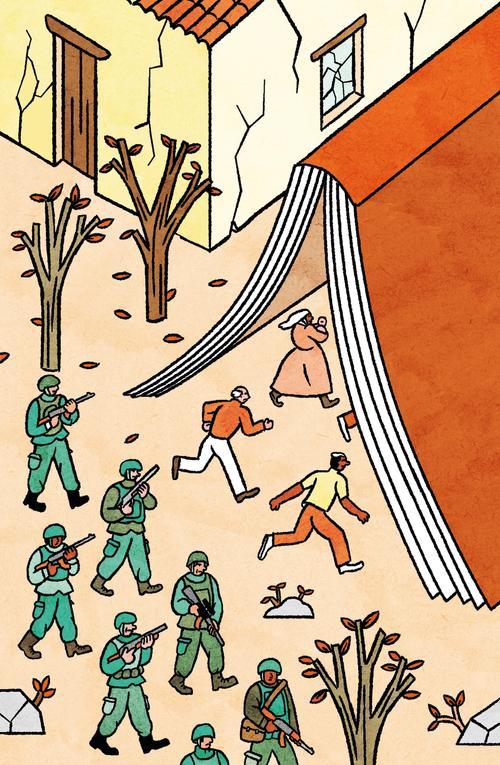
Black humour is a staple of life in places such as Lebanon, where your destiny seems to be beyond your control. The same Lebanese colleague had been late that morning because she was stuck in a traffic jam; the Israelis had bombed a car on the road ahead, killing two people inside. I never did find out who. A Hezbollah commander and his wife? A visiting Iranian financier? It could have been either. You couldn’t know whether the person in the car you were passing, or in the house next door, or on the street as you walked by, might be a target.
Poetry is another way that people survive the fear and uncertainty that war brings. Four lines by Bertolt Brecht have become an aphorism:
In the dark times
Will there also be singing?
Yes, there will also be singing
About the dark times.
After living through the civil war in the 1970s and 1980s, four Israeli invasions, numerous assassinations of leaders, economic collapse and, in 2020, an accidental explosion of nitrates at the Beirut port, which has been described as the most powerful non-nuclear explosion in history, Lebanese people are fed up with being praised for their resilience. A poem by the New Orleans poet Zandashé l’Orelia Brown that starts, “I dream of never being called resilient again in my life/I’m exhausted by strength”, has been circulating on social media. It resonates across borders and cultures.
People often turn to poetry in times of personal grief and trauma, as well as political crisis. This is why, in my career as a reporter often covering conflict, I have always carried a volume of poetry with me. Poetry has an allusive power that journalism lacks; it picks up where we leave off. I turn to it when my own words run out.
Though the TV images we see daily have a huge effect, journalistic language sometimes fails to convey the intensity of the experience. As journalists we pride ourselves on the clarity of our prose and on making complex stories simple. Our job is to explain why terrible things are happening and to challenge the euphemisms used by politicians and military spokespeople. We also try to convey the thoughts and feelings of those we meet and a sense of what it feels like to be on the ground. Yet we may lose the deeper meaning, such as the universal significance of what we have witnessed or the contradictory emotions that war engenders.
On 21 October, Israel bombed, without warning, a building next to the Rafik Hariri hospital, the biggest health facility in Lebanon. Eighteen people were killed. We arrived the following morning to see a bulldozer scraping away at the wreckage. It would stop and the watching crowd would fall silent so that people could listen in case any mobile phones were ringing from inside the mountain of rubble. A man in a red baseball cap with tattooed arms scrambled up and started desperately digging with his bare hands. He was looking for his five-year-old son, Ali. Reaching into the crumbled ruins of his house, Ali’s father pulled out a multicoloured sack. He turned it upside down and a stream of plastic toys poured out, their bright pink, yellow, red and blue stark against the grey ruined concrete. “Are these the Hezbollah weapons?” he shouted. I thought of Anna Akhmatova’s poem about the siege of Leningrad, in which she compares the sound of a bomber to thunder that doesn’t bring blessed rain:
My distraught perception refused
to believe it, because of the insane
suddenness with which it sounded, swelled and hit,
and how casually it came
to murder my child
The shock of the last line echoed the shock I felt in the moment, watching the unspeakable pain of a father who has lost his own.
The dominance of the Great War soldier-poets – Wilfred Owen, Rupert Brooke, Siegfried Sassoon, Isaac Rosenberg – in Western culture might lead to the assumption that war poetry is a male preserve, and that Western poets have a monopoly on the form. This is far from the case. The first known war poet was a Sumerian high priestess, Enheduanna, who lived in Ur, in what is now southern Iraq, in about 2,300bce. Contemporary poetry, much of it written by women, reflects the fact that modern conflicts tend to kill more civilians than soldiers. The late Irish musician Frank Harte said, “Those in power write the history; those who suffer write the songs.” A lot of songs and poems have been written in recent years.
Across the Arab world, poets are revered. Poetry is not seen as an elite pastime but central to culture and identity. Poets may be as important as soldiers in other conflicts too. A statue of Taras Shevchenko, with his massive, drooping moustache, stands in nearly every town I have visited in Ukraine. The reputation of the national poet, who wrote revolutionary verse in the 19th century, has been further elevated by the 2022 Russian invasion. In Borodyanka, a small town near the Ukrainian capital Kyiv, which saw some of the worst of the early fighting, he surveys a bombed-out apartment block, the windows blackened and broken.
More than 150 years on, his struggle is not yet won. A new generation of Ukrainian poets has been born of the war, writing in Ukrainian not Russian, part of an assertion of Ukrainian culture. Focusing on physical suffering, Western journalists may fail to see the importance of art to people struggling to preserve their humanity. Mental health and trauma are a focus but we are often oblivious to spiritual and religious needs, and to the yearning for the comfort of ritual and recitation that poetry provides.
That yearning is increased when people are forced to flee. Refugees bring only what they can carry, which often means songs, stories, poems and prayers that they know by heart. They can’t go back, not just because it’s dangerous but because the country they grew up in no longer exists – war changes everything. They are lost in both space and time. Verses learnt on a grandmother’s knee or in school are anchors to the old life and provide a source of strength and identity that give solace in an alien and often hostile world. In TS Eliot’s words from “The Waste Land”: “these fragments I have shored against my ruins”.
While we ate our lunch in Beirut, the minister’s driver leant against his black four-wheel-drive with its tinted windows, smoking and looking up at the drone, before finishing and whisking his boss away. A few minutes later a new party arrived at the table. They couldn’t have been more different: four fashionably dressed women with bee-stung Botox lips and sunglasses perched on their head. The two divergent sets of table guests are part of the complexity of contemporary Lebanon, land of chuddars and bikinis, political parties with their own militia, and multiple sects and religions. Even in the darkest of times, it’s possible to admire the glory of Lebanon’s contradictions and diversity.
As the great Lebanese-American poet Khalil Gibran wrote in the 1920s:
You have your Lebanon and its dilemma
I have my Lebanon and its beauty
Your Lebanon is an area for men from the West and men from the East
My Lebanon is a flock of birds fluttering in the early morning as shepherds lead their sheep into the meadow and rising in the evening as farmers return from their fields and vineyards
You have your Lebanon and its people
I have my Lebanon and its people
Poets don’t have the answers but they can turn the horror of war into works of beauty. Journalism is of the moment; poetry lasts forever.
About the writer:
Hilsum is international editor at Channel 4 News in the UK. Her new book, I Brought the War with Me: Stories and Poems from the Front Line, is published by Chatto & Windus.
How to celebrate the Feast of the Seven Fishes in 10 dishes
This year’s December/January food shoot aims to keep you sated from Yule to the new year and beyond, and takes its inspiration from the way in which recipes and traditions are refined and changed depending on what you’re celebrating and with whom.
It’s not without a little irony that we’ve looked to the Festa dei Sette Pesci (feast of the seven fishes), an authentically European-sounding name for a firmly Italian Christmas Eve tradition in which seven dishes containing seafood are combined to make a mighty meal. In fact, so little is it known in the old country that the recent reference to it in Hulu’s tense culinary drama The Bear might be many actual Italians’ first taste of the idea.
Like so many rituals – from gifts of myrrh to jolly men with reindeers – the original idea feels far away from how things are done today. Perhaps those far-off Catholic predilections for abstaining from meat before feast days in Italy count for something but the roots of the ritual are less important than the message. Preparing and sharing a meal with your nearest and dearest matters. Oh, and we didn’t put fish in any of the three dessert recipes – and wouldn’t suggest that you do either. Enjoy the spread and buon appetito.
The starters
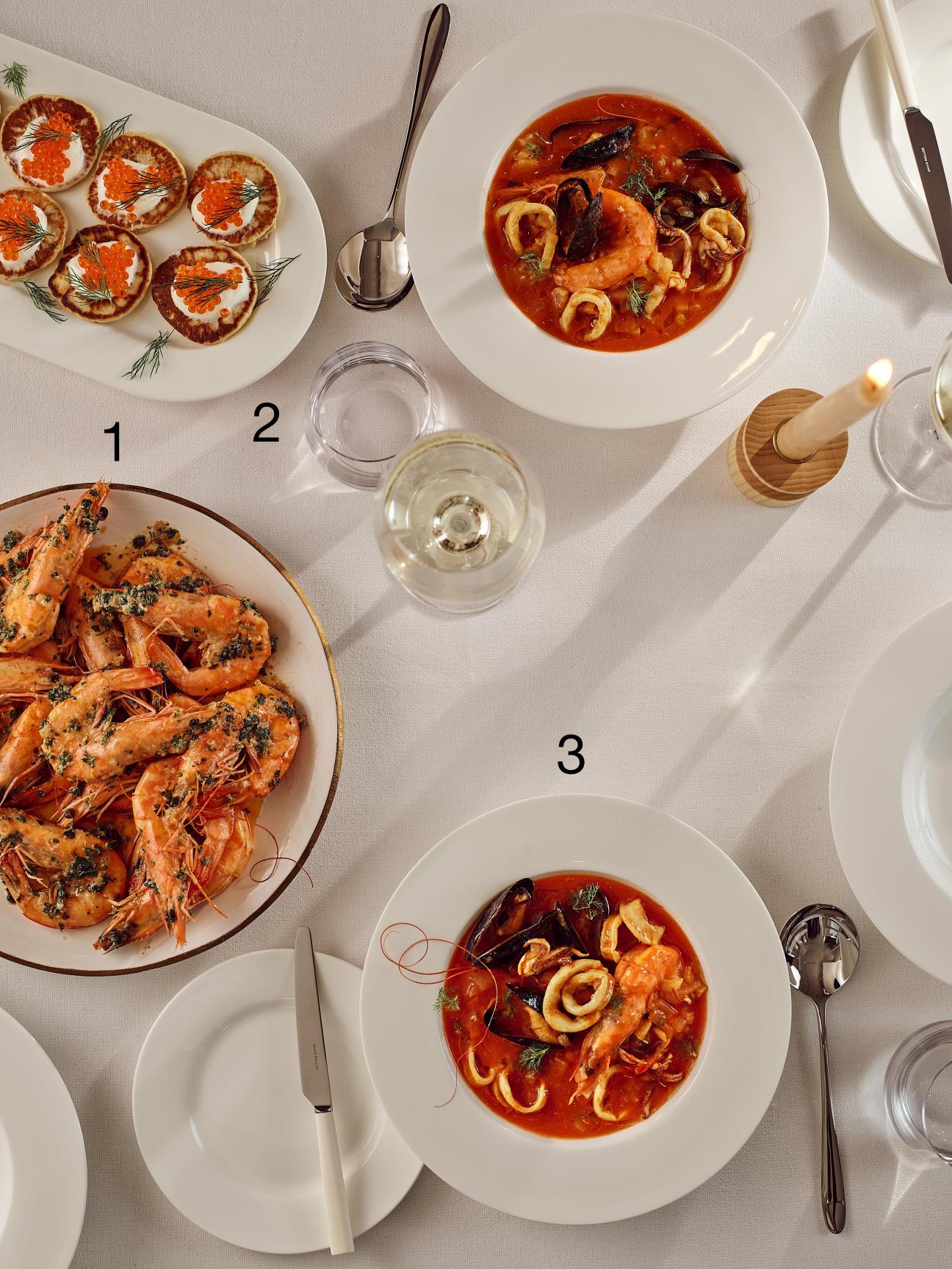
1.
Lemony garlic prawns
Serves 4
Ingredients
12 large prawns (biggest you can find with shells on)
3 tbsps olive oil
4 peeled garlic cloves, finely chopped
3 tbsps good white wine
2 tbsps fresh lemon juice
10g curly parsley, roughly chopped (save some leaves for garnish)
Salt and freshly ground black pepper
Method
1.
Cut the prawns through the shell with kitchen scissors, starting under the head and stopping before the tail. Remove and discard the vein with a fork. Repeat with the remaining prawns.
2.
Heat the olive oil and garlic in a frying pan until sizzling. Add the prawns and cook until they are pink on both sides.
3.
Add the white wine and lemon juice. When the sauce starts bubbling, add half of the chopped parsley, season with salt and pepper, and toss lightly and remove from heat.
4.
Serve the prawns with the sauce and sprinkle with the remaining parsley.
2.
Blinis with trout roe
Makes 16 blinis
Ingredients
40g buckwheat flour
60g strong white flour
½ tsp fast-action yeast
Pinch of salt
100ml whole milk
65ml sour cream
1 medium free-range egg, separated
Vegetable oil (for frying)
220ml sour cream (for topping)
85g trout roe
Small bunch of dill (for garnish)
Method
1.
Prepare the batter by mixing the flours, salt and yeast in a bowl. Make a well in the centre. Heat the milk gently (don’t let it get too hot or bubble) and pour into the well, whisking to combine with the flour. In another bowl, mix sour cream and egg yolk, then add to the dough. Cover with plastic wrap and let stand for 30 to 40 minutes until bubbly.
2.
Whisk the egg whites until soft peaks form. Gently fold them into the batter.
3.
Cook the blinis by heating 1 tbsp oil in a frying pan over medium heat. Drop 1 tbsp batter per blini and cook for 2 minutes per side. Remove and set aside.
4.
Spoon 1 tsp sour cream on each blini, top with ½ tsp trout roe, and garnish with a sprig of dill.
3.
Zuppa di pesce
Serves 4 as a main or 8 as a starter
Ingredients
3 tbsps olive oil
3 garlic cloves, minced
1 tsp fennel seeds
1 onion, finely chopped
1 fennel bulb, finely chopped (reserve fronds for garnish)
½ tsp sea salt
550ml fish stock (or water)
150ml dry white wine
400ml passata
2 large pinches of saffron
400g mussels (washed in running water and debearded)
8 prawns, heads and shells on
300g squid, cleaned
2 tbsps extra virgin olive oil (for drizzling)
Method
1.
Prepare seafood by cutting the squid into rings and slicing tentacles into bite-sized pieces. Using kitchen scissors, cut each prawn shell under the head until just before the tail, then use a fork to remove and discard the vein.
2.
To cook the aromatics, heat olive oil, garlic and fennel seeds over medium-low heat for 3 minutes. Add onion, fennel and a pinch of salt; cook until soft and translucent.
3.
Pour in fish stock or water, passata, white wine and saffron. Bring to a simmer and cook for 10 minutes.
4.
Add mussels, prawns and squid into the pan, then cover and poach gently until the mussels open, the prawns turn pink and the squid becomes opaque. Discard any unopened mussels. Season with salt and pepper.
5.
To serve, divide the soup into bowls, garnish with fennel fronds and drizzle with extra virgin olive oil.
The mains
4.
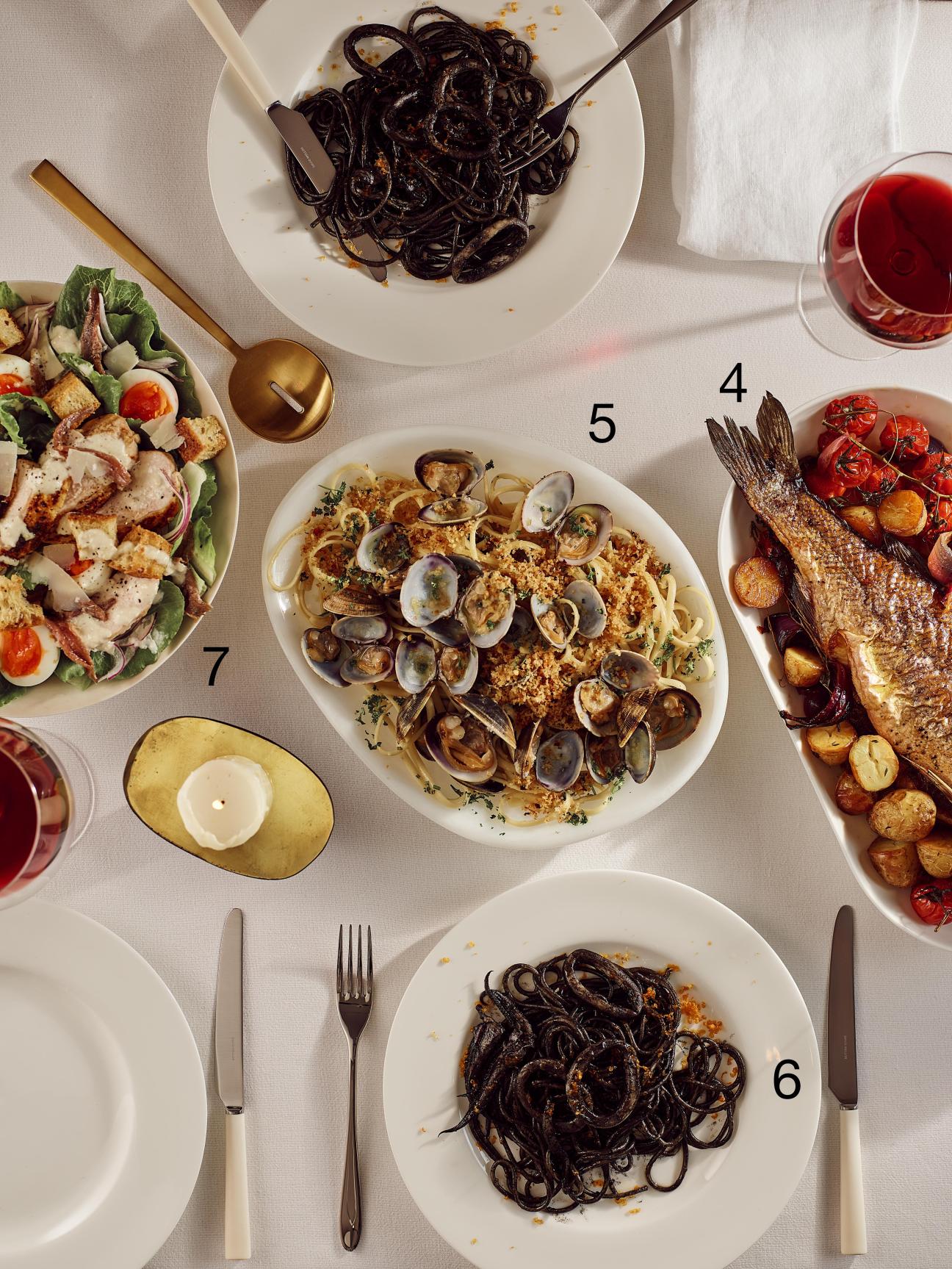
Roasted branzino with grilled courgette
Serves 4
Ingredients
700g whole sea bass, scaled and cleaned
10g dill
1 lemon, thinly sliced
2 tbsps olive oil
400g cherry tomatoes on the vine
2 red onions (¼ of an onion thinly sliced, for stuffing, and 1¾ onions cut into quarters)
750g baby potatoes
1½ tbsps olive oil
3 sprigs fresh thyme
4 courgettes
3 branches fresh oregano, roughly chopped
3 tbsps olive oil
Method
1.
Preheat oven to 180C.
2.
Bring water to boil with ½ tsp salt. Add potatoes and cook for 5 minutes, then drain. Place potatoes in a roasting dish with thyme, salt, pepper and 1½ tbsps olive oil. Roast for 30 minutes.
3.
Prepare sea bass by patting it dry. Drizzle with olive oil, season inside and out with salt and pepper. Stuff with dill, sliced onion and lemon.
4.
Arrange cherry tomatoes and remaining onion in a baking dish, season with olive oil, salt and pepper, and place fish on top. Roast for 35 to 45 minutes. Serve with roasted potatoes.
For the courgette
1.
Slice the courgette lengthwise into 5mm-thick pieces.
2.
Mix slices with olive oil and chopped oregano. Season with salt and pepper.
3.
Heat a grill pan and grill the courgette until grill marks appear on both sides.
5.
Spaghetti alle vongole with white wine and pangrattato
Serves 4
Ingredients
For clams
15g sea salt
1kg clams (from the fishmonger)
For pangrattato (breadcrumbs)
2 tbsps olive oil
2 garlic cloves, finely grated
1 anchovy fillet, finely chopped
30g panko breadcrumbs
¾ tsp chilli flakes
For the pasta
400g linguine
3 tbsps olive oil
6 peeled garlic cloves, finely chopped
150ml good white wine
40g curly parsley, finely chopped
Freshly ground black pepper
Method
1.
Wash the clams thoroughly and set apart evenly in a shallow tray. Stir and dissolve 15g sea salt in 500ml water, then pour the saline solution over the clams, ensuring that they are half-soaked. Cover with a tea towel and leave for a minimum of 30 minutes and up to an hour (for the clams to release any sand). Discard the water and let the clams drain in a sieve for 30 minutes.
2.
Heat oil in a frying pan, add garlic and anchovy, and cook gently until the anchovy dissolves and begins to sizzle. Add the breadcrumbs and stir constantly until golden. Stir in the chilli flakes, then set aside.
3.
Boil water with a generous amount of salt in a large pot. Cook the pasta for 1 minute less than the packet instructions.
4.
To cook the clams, heat oil and garlic in a frying pan until golden. Add the white wine and clams, cover with a glass lid and increase the heat. Remove every clam as their shells open, placing them in a bowl. This will prevent the clams from overcooking and keep them juicy and delicious. Discard any clams that don’t open after five minutes on a high heat but keep the sauce.
5.
Once the pasta is cooked al dente, save 3 tbsps of the cooking water then drain. Add pasta and the retained water to the frying pan containing the clam sauce. Add chopped parsley and black pepper, stirring well to coat the pasta. The sauce should be thickened and glossy. The clams will release some salted water so you shouldn’t need to season with salt.
6.
Divide the pasta and clams between 4 bowls, spoon the crunchy breadcrumbs over the top and serve.
6.
Squid ink pasta with bottarga
Serves 4 as main or 8 as a starter
Ingredients
270g cherry tomatoes on vine
1 tbsp olive oil
Salt and pepper
400g spaghetti
4 tbsps olive oil
4 garlic cloves, minced
1 tsp chilli flakes
400g squid, cleaned and sliced
120ml dry white wine
4 sachets (4g each) of squid ink
120ml pasta water
20g finely grated bottarga (you can buy a whole bottarga from a good fishmonger or a powdered version in many delis or grocery shops)
Method
1.
Preheat oven to 160C. Place cherry tomatoes in a baking tray, drizzle with olive oil and season with salt and pepper. Roast for 15 minutes and set aside.
2.
Bring water to a boil, add salt and cook spaghetti for 1 minute less than the package instructions.
3.
Prepare the squid ink sauce by heating olive oil in a frying pan over medium-low heat. Add garlic and chilli flakes. Stir-in the squid and cook for 2 minutes, then add the white wine and squid ink. Simmer until the sauce is glossy.
4.
Add pasta water to the sauce, then drain the pasta and mix in the sauce. Season with salt and pepper.
5.
Divide pasta into bowls, top with roasted tomatoes, sprinkle with bottarga and serve.
7.
Caesar salad with anchovies and boiled eggs
Serves 4 as main or 8 as a starter
Ingredients
200g ciabatta or 4 slices sourdough, cut into large cubes
2 tbsps olive oil
Salt and pepper
4 medium eggs
600g chicken breast, skin on or off
2 tsps olive oil
1 large romaine lettuce, soaked in cold water for 30 minutes, then drained
1 small red onion, thinly sliced and kept in cold water
8 anchovy fillets
35g parmesan, shaved
For caesar dressing
70g good-quality mayonnaise
½ small garlic clove, grated
1 anchovy, finely minced
1 tbsp apple cider vinegar
1 tbsp fresh lemon juice
¼ tsp light brown sugar or maple syrup
25g parmesan cheese, finely grated
Freshly ground black pepper
Method
1.
To make the croutons, preheat the oven to 180C. Toss bread cubes with olive oil, salt and pepper. Bake for 10 minutes or until golden and crunchy.
2.
Heat a griddle pan over high heat. Season chicken with salt and pepper, and drizzle with olive oil. Grill for 3 minutes on each side, then transfer to an ovenproof dish and bake for 10 minutes or until cooked through. You can test it by piercing the thickest part of the chicken. If the juice runs clear, the chicken is cooked. Let rest for 10 minutes, then slice.
3.
Bring water to a boil, add eggs, and cook for 7 minutes for a soft yolk. Cool eggs under cold running water and peel when ready.
4.
Make the dressing by mixing all dressing ingredients until smooth.
5. In a large bowl, toss the lettuce, drained red onions and croutons. Arrange rge chicken slices, halved eggs and anchovies on top. Sprinkle with shaved parmesan, drizzle with dressing and serve.
The desserts
8.
Recipe
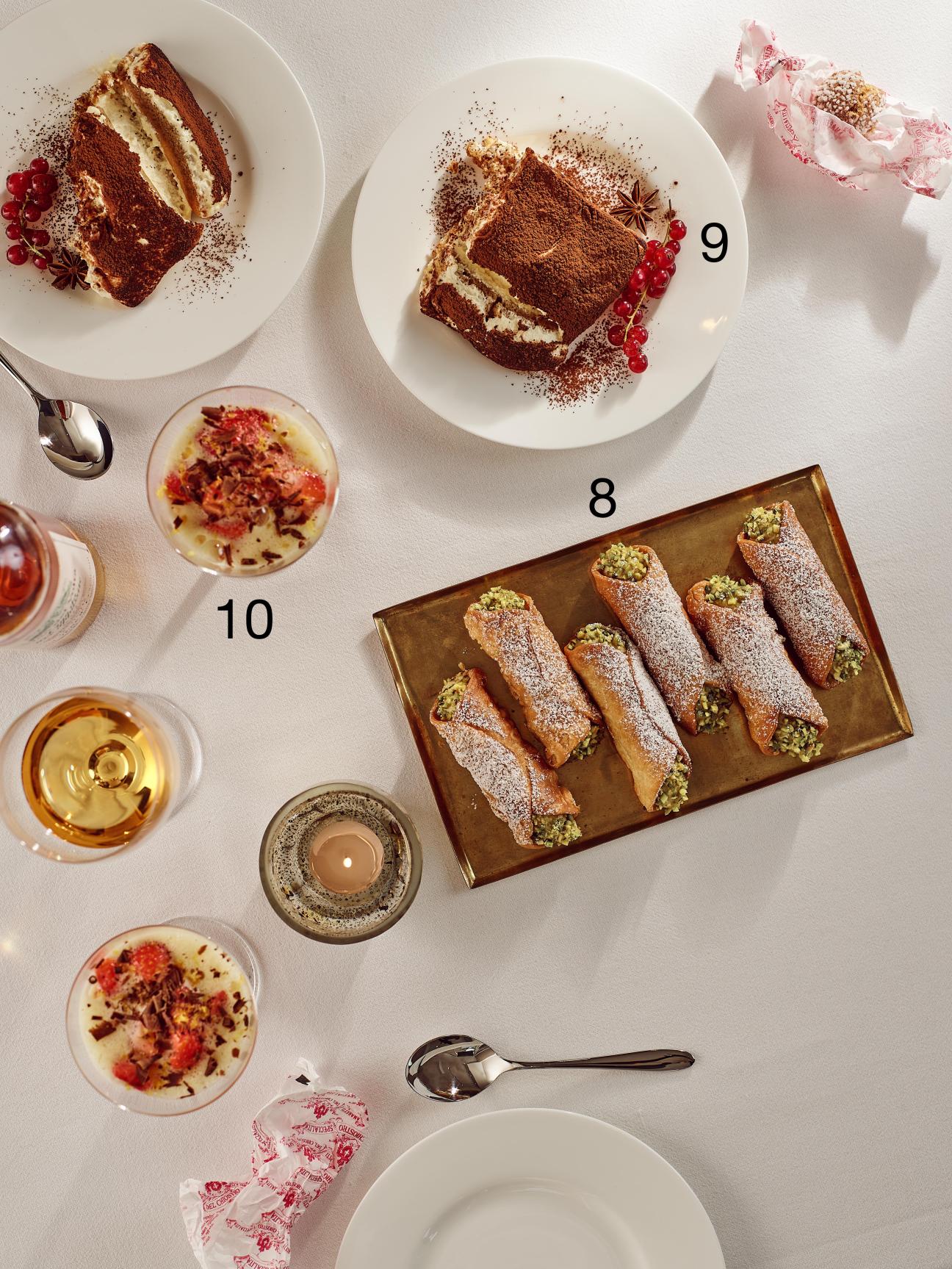
Cannoli with pistachio cream
Makes 12
Equipment
12 cannoli moulds
Pasta machine (optional)
Ingredients
For cannoli shells
180g plain flour
2 tsps caster sugar
¼ tsp salt
30g cold unsalted butter, cubed
1 medium egg, separated
50ml marsala wine
Vegetable oil (for frying)
For pistachio filling
500g ricotta, strained for 1 hour
60g icing sugar
8 tbsps pistachio butter
20g pistachios, roughly chopped
Icing sugar (for dusting)
Method
1.
To make cannoli dough, mix flour, sugar and salt in a bowl. Rub in butter until combined. Mix egg yolk and marsala wine in another bowl, add to flour mixture and mix until it forms a dough. Knead the dough on a floured surface, until it becomes smooth. If the dough is still sticky you can add more flour. Wrap it in cling film and let it rest for 30 minutes.
2.
Mix the ricotta, icing sugar and pistachio butter. Place in a piping bag and refrigerate.
3.
To shape the cannoli, roll dough to 1mm in thickness, cut into 11cm circles. Wrap around cannoli moulds and seal with egg white.
4.
Heat oil to 160C. Fry cannoli for 1-2 minutes until golden. Remove moulds, fry cannoli for an additional 30 seconds, then leave to cool.
5.
When cannoli is ready to serve, pipe the filling into shells (don’t do this too far ahead of time or the pastry may become soggy), dip ends in chopped pistachios and dust with icing sugar.
9.
Tiramisù di Natale
Serves 6 to 8
Ingredients
4 medium eggs, separated into yolks and whites
120g caster sugar
250g fresh mascarpone cheese
100ml double cream
180ml espresso (about 5 shots)
30 finger sponges
1 tbsp cocoa powder
Star anise and redcurrants (or other red berries) for decoration
Method
1.
To make the cream, beat the egg yolks with half the sugar until pale and airy. Add the mascarpone and mix until combined.
2.
In a separate bowl, whip the double cream until soft peaks form, then gently fold into the mascarpone mixture.
3.
Beat the egg whites.
4.
In another bowl, beat the egg whites until they form stiff peaks. Gradually add the remaining sugar, one spoonful at a time, and beating well after each addition. Gently fold one-third of the egg whites into the mascarpone cream, then fold in the rest to keep the mixture light and airy.
5.
In a 20cm x 25cm x 5cm dish, layer half of the finger sponges and drizzle with half of the espresso. Then spread half of the mascarpone cream over the sponges. Repeat with the remaining sponges and cream.
6.
Dust the top with cocoa powder, cover, and refrigerate for at least an hour or, ideally, overnight. To serve, decorate with star anise and redcurrants.
Chef’s tip: This recipe can – and should – be prepared a day in advance.
10.
Zabaione with strawberry
Serves 4
Ingredients
400g strawberries, halved
2 tsps caster sugar
4 tsps fresh orange juice
Grated orange peel
For zabaglione
50g caster sugar
4 medium egg yolks
80ml marsala wine
15g dark chocolate (optional, for garnish)
Amaretti biscuits or finger sponges (for serving)
Method
1.
Mix strawberries with caster sugar, orange juice and half of the grated orange peel, and leave to macerate.
2.
To make the zabaglione, bring water to a simmer in a saucepan. In a heatproof bowl, whisk sugar, yolks and marsala over the simmering water until creamy and fluffy (you can use an electric hand mixer for this).
3.
Divide strawberries into glasses, spoon over zabaglione, and sprinkle with grated chocolate and the remaining orange peel. Serve with the biscuits or finger sponges.
Hungry for more?
Hosting a Christmas dinner isn’t the only chance to be creative in the kitchen. Get a new recipe every Sunday in The Monocle Weekend Edition newsletter. Sign up for free at monocle.live/minute
The man reinforcing Roger Vivier’s bejewelled legacy
Bejewelled buckles on shoes might once have brought to mind royal portraits from the 17th century but in today’s fashion industry they call forth one name only: Roger Vivier. The Parisian maison has perfected the twinkle of its shoes since it was founded by the French designer in 1937. Vivier pushed the boundaries of footwear, partnering with Christian Dior to develop his New Look silhouette and providing pumps for Catherine Deneuve in 1967 erotic psychodrama Belle de Jour. When the designer died in 1998, he left behind a maison and a legacy that still evoke glamour.
In 2015 the house was bought by Italian holding company Tod’s Group for €415m. And Italian designer Gherardo Felloni was installed as creative director in 2018 – very successfully, as it turns out. Last year, overall revenue increased by 16.5 per cent to €286.7m.
“I’ve always looked to Roger Vivier as a reference for my own career,” Felloni tells Monocle. “He was an inventor, a genius.” He is wearing one of his go-to outfits: a crisp shirt and a simple navy cardigan accentuated with an antique gold necklace, dripping with pearls. “Vivier designed for the contemporary women of the 1950s, 1960s and 1970s. That’s why one of the first shoes I designed for Roger Vivier was a trainer. Women today want to be comfortable. Sometimes I joke that Vivier, if he were alive today, would have worked on trainers. So I did it for him.”
The CV
1980: Born in Tuscany.
2003: Begins his career in fashion as a shoe designer for Helmut Lang and Fendi in Italy.
2009: Moves to Paris to work for Christian Dior and then Miu Miu as design director, while also studying opera.
2018: Appointed creative director of Roger Vivier where, inspired by the maison’s cinematic heritage, he releases a short film featuring Catherine Deneuve.
2023: Launches the Pièce Unique collection, a tribute to craft, archives and couture.
2023: Wins the Footwear News Achievement Award for Shoe Designer of the Year.
2024: Launches the Vivier Express series of short films starring Laura Dern and Eva Green.
Felloni had previously worked in the accessories and footwear departments of labels including Fendi, Dior, Miu Miu and Prada. But, for him, being appointed the creative director of a house with a visionary founder is somewhat akin to entering into dialogue with someone beyond the grave. Shared passions such as gardening, jewellery and a playful approach to design facilitates that conversation. “I never knew Vivier but from the archive you can tell that he didn’t take himself too seriously,” says Felloni. “He wanted to make fashion contemporary and light. And I believe that fashion is a moment for creativity but also for the clients to have fun.”
Growing up in Tuscany, Felloni considered a career in opera, cinema or architecture. But the calling came from closer to home: his father and uncle ran the family shoe factory, where he spent his childhood learning about the complexities of shoe construction. “Shoes aren’t like a bag or a dress: the form needs to support the foot so you can walk,” he says. “The technical part of my job is important to me.” This early exposure to manufacturing also instilled in him a reverence for craft from an early age. Now, at Roger Vivier, Felloni works with the house’s atelier to develop new designs but also to reiterate and update shoes that he finds in the archive.
His aim is to communicate the savoir-faire and rarity of the maison to customers through opulent salon-style presentations of not only shoes but accessories including bags, belts and headbands. For the house’s campaigns, Felloni has tapped actors including Deneuve, Isabella Rossellini, Laura Dern and, most recently, Eva Green as brand ambassadors. “The women I’m obsessed with all have confidence in common,” he says. “When you’re confident, you can wear whatever you want. You don’t think about other people’s opinions. You’re free. That is what inspires me.”
Playlist: 50 cosy songs for long, dark nights
Morning sun
There’s nothing like the sunlight on a crisp winter morning. Allow these tracks to provide a gentle, warming accompaniment.
1.
Todo Dia Santo
Marcos Valle
Brazilian legend Marcos Valle delights with his breezy, effortlessly cool bossa sound.

Marcos Valle
Brazilian singer and producer
What are you listening to currently?
On the road, I like to listen to playlists that I’ve made. I’m also listening to Céu’s new album, Novela, which is very nice, very beautiful. She wrote lyrics for a song on my album, which I love. And to tell you the truth, I listen to Ravel and Debussy in the quiet moments.
What are your plans for 2025?
I recently released a new album, Túnel Acústico, so I’ll continue touring it in Brazil, Europe and the US. We’re also planning to tour in China. Another project that I’ve been working on is a music series by [the late] French composer Henri Salvador, which I artistically directed, produced and did arrangements for. It’s becoming an album and will also be turned into a show, which will be toured. Beyond that, I don’t know. I can only to wait and see what will happen.

Do you have any New Year’s traditions?
I prefer to stay at home with my wife, Patricia, and our little dog, Merlot. If I’m performing on New Year’s Eve, it’s got to be something very special. Otherwise, I prefer to relax. I think that’s the way to be prepared for a new year.
2.
Moonlit Floor
Lisa
A member of K-pop group Blackpink, Thai singer Lisa shines in this track that riffs on 1990s classic “Kiss Me” by Sixpence None the Richer.

3.
Cinnamon and Clove
Sérgio Mendes & Brasil ’66
Another bossa nova classic, selected in tribute to the late Sérgio Mendes, who passed away in September.
4.
Sinking Boat
Infinity Song
Soft rock from four talented New York siblings.
5.
Crockett’s Theme
Jan Hammer
The iconic Miami Vice theme.

6.
Turbo
Sunni Colón
Mornings are always smoother with a little Sunni Colón.
7.
Rosário do Desejo
Ayom
A sunny blend of lusophone styles, from Brazilian frevos to Cape Verdean coladeiras.
8.
Love Me Jeje
Tems
This Tems track revamps Seyi Sodimu’s 1997 Nigerian Afro-pop hit of the same name.
9.
Amor em Jacumã
Lucas Santtana
Let cool Brazilian dub beats ease you into the day ahead.
10.
Erase/Rewind
The Cardigans
We never get tired of this one.
Walk in the park
Want to blow off the cobwebs with a walk? Grab your headphones…
1.
Somente o Sol
Deborah Blando
The Italo-Brazilian legend delivers a stirring cover of 10cc’s “I’m Not in Love”.
2.
Cruz de Navajas
Mecano
A Spanish new-wave classic.
3.
Amar Pela Metade
Calema
Kizomba pop from a duo with São Tomé and Príncipe roots.
4.
Sciura Milanese
Popa
A slick synth-pop tribute to the sciuras – the name given to chic older ladies in Milan.
5.
Ortak
Melike Sahin
New soulful pop from one of Turkey’s biggest stars.
6.
Power
Telenova
Alt-indie from the Melbourne trio’s 2024 debut album, Time Is a Flower.
7.
Si Antes Te Hubiera Conocido
Karol G
The Colombian singer dominated this year’s charts with this bouncy track.
8.
Leh Benkhaby
Tul8te
This masked singer and producer blends pop with bossa nova and Egyptian sounds.

9.
Acidente
Jão
Melancholic pop by the young Brazilian singer-songwriter.
10.
Cool Breeze
The Jeremy Spencer Band
Let this cinematic yacht-rock track whisk you to the 1970s.
Aperitivo hour
Whether you’re enjoying an aperitivo at home or après-ski on the slopes, these songs will kick-start your evening.
1.
I Forget (I’m So Young)
Sofie Royer
Shimmering up-tempo electro-pop from the Austrian singer.

2.
Desliza
Ana Moura
Short, sultry and infectious, this new track from the Portuguese fado artist will get you moving.

3.
Nenuphar
Polo & Pan
The French duo’s electro-disco track is inspired by Mexico City and its grooves are guaranteed to spice up your evening.

4.
Air
Crystal Murray
Emotional pop-r&b from the Franco-American singer.
5.
Una Notte Speciale
Alice
This dreamy synth track became a classic upon its release in 1981.
6.
Total Normal
Michael Cretu
Top synth-pop by the Romanian-German music producer.
7.
Diet Pepsi
Addison Rae
Simply a perfect pop song.
8.
Veridis Quo
Daft Punk
Luca Guadagnino selected this for his new Chanel No 5 ad.
9.
Esperar Pra Ver
Evinha
Pure bossa nova brilliance.

10.
Uciekaj!
Lor
Exciting Polish folk-pop.
Hedonistic night
Escape the cold and lose (or find) yourself on the dance floor with these club-ready songs.

1.
Ô travers
Zaho de Sagazan
The acclaimed star combines French chanson with electro.

2.
Galactic Romance
Jaakko Eino Kalevi(Kiva Kiva Versio)
Italo-disco collides with Finnish melancholy – and it works.
3.
Serotonin Moonbeams
The Blessed Madonna
A love letter to 1990s rave.
4.
Acid in My Blood
Channel Tres
Techno to get lost in.
5.
Pump It Up
Endor
Featured on the soundtrack of one of the year’s buzziest films, The Substance.
6.
Nightcall
Kavinsky, Angèle & Phoenix
Revived when it was performed at the 2024 Olympic Games closing ceremony.

7.
Taboo
Kylie Minogue
Classic Kylie from this year.
8.
Dancing Island
Angelina Petrosova
The Uzbek diva in full flow.
9.
Life
Jamie xx, Robyn
Let optimism banish the blues.
10.
Mystery of Love
Mr Fingers
A famed Chicago house track.
New Year’s celebrations
Raucously ring in 2025.
1.
Tout Pour Moi
Clara Luciani
An uplifting song from new album Mon Sang.

2.
Fantasy
Jade
The former Little Mix member turns disco diva.
3.
Bafana Bafana
Professor Rhythm
Recorded at the end of Apartheid.

4.
Nandakke?
Aili
Delicious electro-pop by the Belgian-Japanese duo.
5.
Somebody to Love
Kazy Lambist
It’s all about love in this gem.
6.
Time for Celebration
Dov’è Liana
Indie with an Italian twist from the French trio.
7.
La Bohème
Mauvais Oeil
Pop inspired by Arab divas.
8.
Promised Land
Joe Smooth
Start your year by bouncing.
9.
Ti Voglio
Ornella Vanoni, Elodie, Ditonellapiaga
A new version of a classic track by Italian icon Ornella Vanoni.
10.
Rescue Me
Madonna
Gospel for the dance floor.
Monocle Radio
To listen to the playlist, search “Monocle Radio” on Spotify or tune in live. Our radio station broadcasts around the clock, seven days a week. You’ll find more music alongside a daily mix of comment, analysis and news shows across the schedule. Head to monocle.live/radio or download the programmes as podcasts wherever you get your audio.
Keeping it real: Why meeting prospective employees in person yields the best results
The job interview’s reputation is almost universally negative. But outside of TV sitcoms, are old-fashioned, in-person meetings with prospective employers ever that bad? The alternatives certainly are. As with so much else from the analogue world, we might already be suffering from the job interview’s increasingly endangered status. When UK-based recruitment consultants CV Genius surveyed 625 hiring managers on what they look for in a successful job application, 80 per cent responded that they couldn’t stand AI-generated applications. But there’s a trusty implement in the recruiter’s toolbox that can save us from hiring the wrong candidate: meeting them in person.
The consequences of letting someone get too far into the job-application process without having met them are obvious. Not only does an AI-generated CV and covering letter give the employer no idea whether the candidate’s self-professed acumen stands up to scrutiny but they also offer little indication of the personality type that could be about to enter your working life.
It’s time that we scotched the encroachment of AI into the hiring process by reviving mandatory, in-person job interviews and holding them as early into proceedings as possible. They might be stressful for many candidates and time-consuming for bosses but they also reduce the chances of hiring someone who has been dishonest in their application. They are also a vote in favour of that increasingly rare but precious element of the working day: human connection.
It doesn’t matter how gleaming someone’s written job application is, whether it’s bot-created or not. You simply can’t get a full measure of a candidate without spending some time together. Not only does the employer get an insight into an applicant’s acuity, style and sense of humour but the candidate, in return, gets to find out the same things about their prospective boss too.
AI has become worryingly adept at gaming written job applications. Generic questions such as, “What can you bring to this role?” and, “What do you consider your strengths and weaknesses?” are catnip to bots. To vet potential employees properly, all predictable elements of job questionnaires should be expunged. The requests should be so specific that AI will wither on the digital vine. It would be difficult for a candidate to use Chatgpt to answer a question such as, “Please could you illustrate an example, directly referencing your previous position, of when you solved a problem, detailing the specifics of the situation and giving us a step-by-step narrative of your response to it?”
AI is problematic in other, more disturbing ways. A University of Washington study published in 2023 tested three large-language AI models by making them evaluate hundreds of CVs against job descriptions. They found that the models favoured CVs from candidates with white-associated names 85 per cent of the time – and preferred other candidates to black men 100 per cent of the time.
The endgame of this reliance on AI will be horribly retrograde. Successful candidates will be chosen based on whether they are the most clued up on how to use the technology to their advantage. There is also the risk that bosses will simply become distrustful – and heartily bored – of the entire process and give the job to someone in their social network. Goodbye, meritocracy.
So, if we really want to hire the best candidate for the job, we need to tidy our office desk, find another chair, take a coffee order and usher in the first of those aspirant future employees.