Issues
The clinic selling ‘scientific wellness’ in the heart of Bangkok
Wellness is a fast-growing industry in Thailand and Bangkok Dusit Medical Services (BDMS), the country’s largest private health-care group, has set its sights on becoming a global leader. Thailand’s flagbearer for preventative medicine, BDMS has a flagship address in central Bangkok and a portfolio to match, including 60 hospitals, drug-making laboratories and a nationwide pharmacy with more than 140 stores.
A decade ago, the group’s late founder, Prasert Prasarttong-Osoth, decided to build the standalone BDMS Wellness Clinic in the Thai capital’s Lumphini neighbourhood and appointed doctor-turned-longevity-guru Tanupol Virunhagarun (also known as Dr Amp) as its CEO.
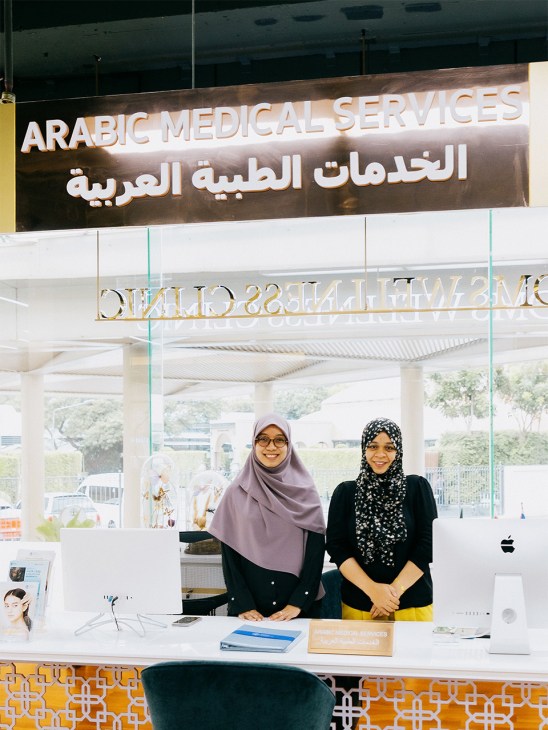
The clinic now accounts for 12 per cent of the wider group’s revenue. Dr Amp plans to reach 20 percent within the next five years. Across eight storeys, its services range from fertility and brain health to an on-site lab making personalised supplements. Its suite of blood tests, scans and other procedures measures organ health, hormone levels, cancer risk, muscle density and biological age.
The gold standard “Blueprint” package to screen for cancers, degenerative illnesses and gut biomes costs €15,000 and requires upwards of 20 tubes of blood, a team of doctors and a catalogue of machines. “We call this scientific wellness,” says Virunhagarun when Monocle visits. “Coronavirus helped us by raising awareness and encouraging people to take better care of themselves.”
The clinic is designed to look more like a house than a hospital; a chandelier-strewn home that’s accustomed to welcoming VIPs. “Health is the new luxury and we sell life to people around the world,” says Virunhagarun. Some 70 per cent of patients are international and many fly in from the Middle East. Monocle spots several middle-aged men from the Gulf roaming the clinic in blue pyjamas, while wives and kids move from couch to couch, waiting for dad to finish.

By the end of the decade, these family visits several times a year could turn into a more permanent arrangement. Last year, the BDMS Wellness Clinic broke ground on a mega-complex called Wellera, slated for 2029. The mixed-used development will combine a hotel, clinic, fitness studio, retail, restaurants and 262 residences on a plot overlooking Lumpini Park.
The €400m investment is double what BDMS spent on the flagship clinic a short drive away. Besides hospital-grade air and water across the two towers, a nurses’ station will be manned around the clock, ambulances will be on standby and a helicopter ready to fly to Bangkok Hospital. Virunhagarun talks about a drone pad for transporting clients at even greater speed. “No one in the world has done a wellness concept like this before,” he tells Monocle before we head off for a swim and an early night.
bdmswellness.com
Hop on board: Six luxurious train routes to take this summer
As turbulent geopolitics play havoc with air travel, this could be the summer of spontaneous rail journeys. There’s little that’s more comforting than the lulling rhythms of an overnight train, especially when you are assured a snug bed and unrivalled views.
Luxury train companies have upped their game in recent years, with notable examples including Belmond’s excursions across South America and Rovos Rail’s weeklong South African journeys. The Golden Eagle Silk Road Express whisks travellers from Beijing to Tashkent in opulent interiors with stops in ancient locations, including Samarkand and Xi’an. And if you’re looking for a Rocky Mountains adventure, Canyon Spirit’s new Denver to Salt Lake City itinerary offers just that (plus all the trimmings).
Imminent arrivals on the scene, such as France’s Le Grand Tour, are also offering a refreshing mix of retro glamour and modern comforts. Slower forms of travel have their unique charms. Watching the landscape gradually change outside the window as your train cruises across a country (or even a continent) is a rewarding, meditative experience – made all the more pleasurable by plush upholstery and a well-assembled drinks menu.
So if you have your eye on a slower, more scenic itinerary this summer, here is our departure board of new routes leaving from a station near you.


1.
China – Uzbekistan
Route: Beijing to Tashkent
Operator: Golden Eagle Silk Road Express
Length: 22 days
2.
USA
Route: Denver to Salt Lake City
Operator: Canyon Spirit
Length: 3 days
3.
Australia
Route: Adelaide to Darwin
Operator: The Ghan
Length: 4 days
4.
Japan
Route: Kyushu round trip
Operator: Seven Stars
Length: 1 – 3 days
5.
France – Italy
Route: Paris to the Amalfi Coast
Operator: Orient Express
Length: 3 days
6.
Spain
Route: Madrid to Seville
Operator: Al Andalus
Length: 7 days
Comment
Slower forms of travel have their unique charms. Watching the landscape gradually change outside the window as your train cruises across a country (or even a continent) is a rewarding, meditative experience – made all the more pleasurable by plush upholstery and a well-assembled drinks menu.
Last orders for Star on 18, the classic Manhattan street-corner diner
For a while it seemed as though the standalone diner on the corner of Manhattan’s 10th Avenue and 18th Street would reach its 100th birthday. But its prime location beside an empty lot in the Chelsea neighbourhood – once a big advantage – has turned out to be its downfall. Star on 18 has gone by a few names in its time and been subject to several makeovers. A photograph taken in 1940 shows the metal-clad structure in the shadow of a sagging tenement.
Pre-fabricated, portable “railroad cars” of this kind – named for their interiors, reminiscent of a train’s dining wagon – were traditionally made in New Jersey, then hoisted onto a truck bound for whichever bit of New York offered a siding of empty space. In the mid-20th century, they were ubiquitous.
A 1980 snapshot of the Star on 18 building – then known as Corfu Diner, a nod to its Hellenic-American ownership – shows its metal shell dented, timeworn and etched with graffiti. At the end of the 20th century, the Gioulis family took it over. “My parents came from Greece,” the current owner, Betty, tells Monocle as she taps on a calculator at the till, on one of the diner’s final days in business. “We had another diner in Midtown called Starlight that we gave to someone else, so we called this one Star on 18.” Betty shrugs. “Starlight closed.”
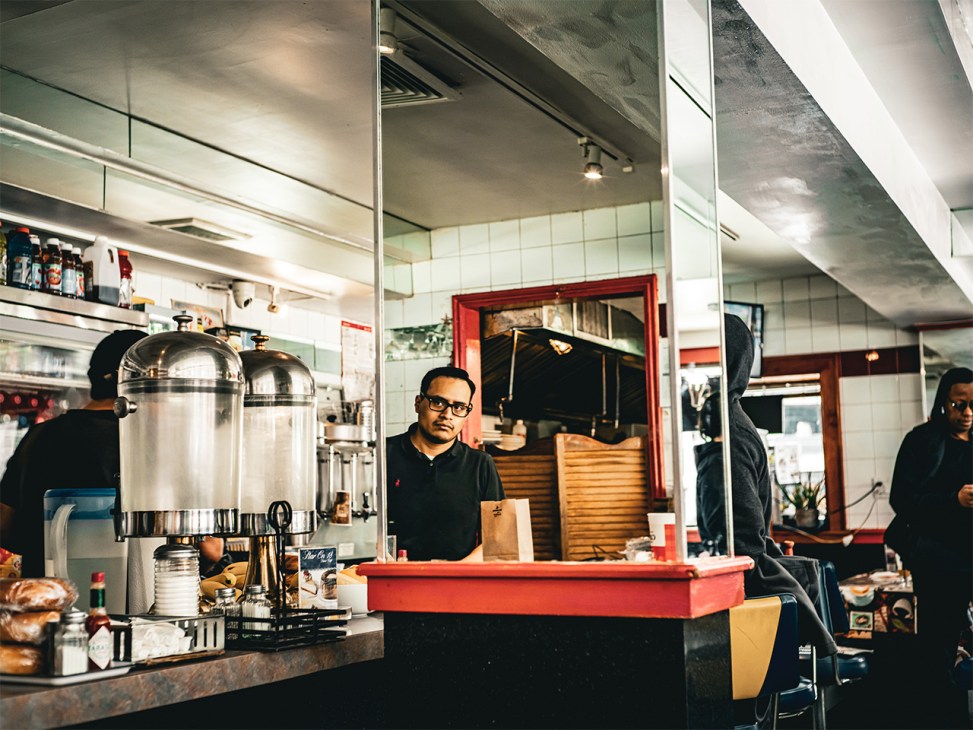
Now this neighbourhood institution is closing too. It outlasted most of its peers and its departure leaves just three diners of its type in Manhattan. It’s a victim of change that has been supercharged by the flourishing of the High Line, directly opposite. The elevated railway track was transformed from a debris-strewn ribbon of weeds into a much-loved walkway and urban attraction. Today almost everyone wants to live beside it and property in the area is at a premium.
Some have long considered Star on 18 as one of this glass-and-concrete metropolis’s last remaining spots of chaos and colour. The laminated menu offers everything from cereal to the “diet delight” chicken and spinach. Bacon rashers and eggs sizzle on a grill, while fries seethe in the golden depths of a deep-fat fryer. Steaming food is whisked through a serving hatch. Blue and yellow booths seat a few dozen customers when it gets busy. Here, bus drivers mingle with High Line staff and local residents, and a steady stream of out-of-towners rub shoulders with hungry families. “We get all types,” says Betty.
There’s no fanfare around the end of Star on 18. Few seem to know that its doors are closing. Change in cities can happen too gradually to discern with the naked eye. “This place is one of those last, stubborn holdouts,” says Phil, a regular. “It’s a proper diner on the corner.” As for Betty, she’s eyeing up an opportunity in Long Island City. “We’ll see,” she says. “If it comes off, maybe it’ll be a new Star.”
Further reading:
Monocle’s complete city guide to New York
Where to shop in Manhattan now: Five multi-brand retailers worth visiting
The irreplaceable value of humanity in the age of AI
Our relationship with artificial intelligence is a paradox of intimacy and alienation. We are endlessly curious about testing a machine’s limits but also harbour a quiet dread that, as algorithms improve, our humanity is somehow being diminished.
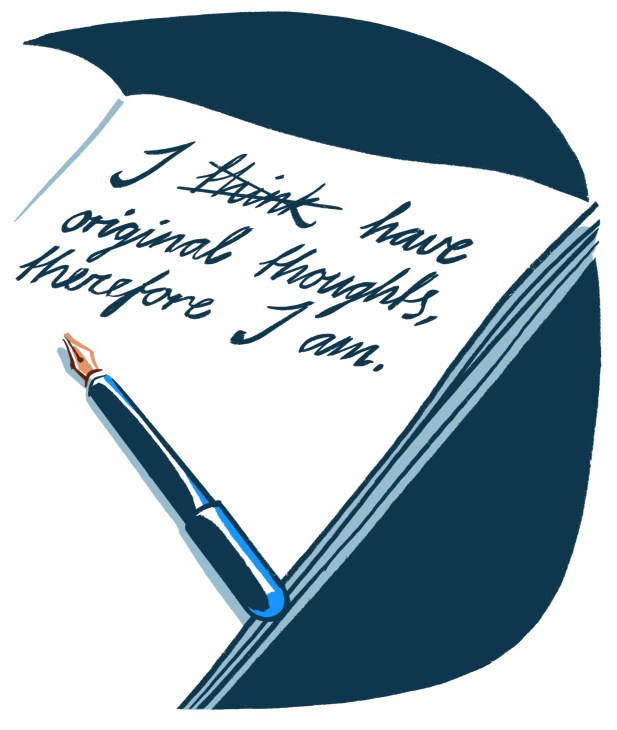
The industry claims that we are on the cusp of “artificial superintelligence” – a notion that implies that intelligence is a matter of mere computation and logic. But I disagree. I tend to think of it more as a feature of experience, of being alive. Optimists view AI as a crane for intellectual heavy lifting, while sceptics see it as a threat. The truth lies somewhere in between. Machines might soon hold a monopoly on facts but humans will always be able to fall back on their birthright: their humanity. Through global AI workshops and decades of teaching and consulting (and occasionally redesigning a good old-fashioned newspaper), I have identified four areas where humans will always have an edge – where we will remain the pilots and machines will be the passengers.
Matters of experience
In early 2026, Yann LeCun, the former chief AI scientist at Meta, argued that the current obsession with large language models (LLMs) such as Claude or Chatgpt is a “dead end”, because they fall down for a lack of what he called a “world model”. While LLMs require the equivalent of 400,000 years of reading to function, a four-year-old human can attain superior logic in just 16,000 hours.
The difference is that text is a low-quality abstraction, while tactile experience offers a high-bandwidth education: in gravity, spatial constraints and physics. AI could, for instance, describe a glass falling off a table but it can’t feel or understand the physical stakes.
In Gabriel García Márquez’s novel One Hundred Years of Solitude, there’s a description of blood flowing out of a house, turning corners and climbing steps to find a mother’s feet. AI could perhaps calculate the viscosity and coordinates of that path but it lacks the world model to understand the gravity – physically and emotionally – of the journey. If we were to rely solely on AI, we would produce a world of realism without magic.
Once more, with feeling
A human writer can grasp the weight of mortality. An AI merely works out the frequency and placement of the words used to describe it. The technology presents what it finds; humans write and draw what they feel.
When Hamlet ponders, “To be, or not to be?” AI can identify the full line’s iambic pentameter and the statistical probability of the next word. However, it cannot comprehend the cultural ghost of the question – the intersection of honour, grief and historical context. Where humans inhabit and understand the struggle, AI recites a script. It exists in a vacuum of data and doesn’t wonder about its place in the universe because it doesn’t occupy a place. It occupies a server. “AI is changing the signature of creativity,” says Nina Begus, the founder of the artificial humanities group at the University of California, Berkeley. “While creativity might no longer be solely in the human domain, this tension is bringing more value to biological and embodied intelligences.”
Star quality
Roberto Trotta, a theoretical physicist based at the Scuola Internazionale Superiore di Studi Avanzati in Trieste and Imperial College London, suggests that human intelligence has been shaped by an ancestral need to navigate the cosmos. We need to contemplate our place within it – to be “starborn”, as he poetically puts it. AI operates in a silicon silo, lacking the existential stakes of metabolism and mortality. When I ask Trotta how he views the role of creativity as AI surges, he says that originality is exclusively human.
Consider Salvador Dalí’s surrealist paintings of melted clocks. To an AI, these are distorted pixels. To a human, they might represent finitude. We comprehend the metaphor, the “softness” of time, because we age and decay. An AI, existing in a timeless digital fugue, has the optics of the image but lacks the existential vertigo of a creature that lives and dies by the clock. “Human-generated content will increasingly become premium, like organic food today,” says Trotta. “AI slop for the masses, certified human for the few – human certification will add a veneer of exclusivity, becoming a status symbol of sorts.”
Following the scent
The phrase “scent of the human” came to me during a speech that I delivered at a conference for journalists in Bergen, Norway. The audience immediately recognised what it meant, which signalled something important that reporters seemed to pick up on intuitively. Human intelligence is informed by subconscious processing: of pheromones, stress markers and the visceral understanding and interpreting of other living beings. This scent also underlines the irreducible essence of empathy and trust. Until a machine can share the breath and the organic signature of life, it will remain a mind without comprehension: a nose without scent receptors.
A war correspondent reporting from the ruins of a city, for instance, doesn’t just see devastation. He or she smells it, sensing the mix of pulverised concrete alongside the hunger on a child’s face. An AI can analyse a drone feed and classify rubble through pixels but it’s immune to the atmosphere of trauma: the odours and subtle signals that it could never intuit. It can report a flow of casualties but not inhale the human tragedy.
Present and correct
I predict that the most influential creators 10 years from now won’t be those who can prompt the most complex algorithms. Instead, they will be people who can plant their feet firmly on the ground and proclaim, “I was here.” In an era of infinite, seemingly perfect but totally synthetic content, the most valuable commodity will be humanity: unprogrammable evidence that a story passed through a living limbic system.
Human creativity isn’t a statistical derivation of what came before. It’s an organic response to being alive, to being afraid and to being together. AI might hold the map of our collective past but only a human – grounded in the physical, a witness to the present – can fathom the way forward.
Three key takeaways
1.
The map versus the terrain: AI might know the co-ordinates but humans can feel the ground.
2.
Information versus wisdom: Where machines can process data, humans experience meaning.
3.
The mirror versus the source: The technology reflects our past. Human creativity can still shape the future.
About the writer:
The CEO of Garcia Media, Mario Garcia is also an adjunct professor at Columbia University’s Graduate School of Journalism. His next book is The Virtuoso Machine: Finding the Scent of the Human at the Controls of AI.
Your verbs are more powerful than you think: Why thoughtful language matters even more today
“If you need me,” said the server, handing out menus, “just ‘Hey, lady’ me.” I had just sat down in a busy diner in the mountains of North Carolina, a place where plainspoken friendliness is as common as bears in the backyard. Even so, this woman’s cheerful suggestion disarmed me. I liked her panache. She had flipped what is ordinarily a rude exclamation into a signal of warmth and subversive wit. She had made it a positive verb.
I have been thinking about the power of verbs as our language slips out of our control. AI slop and autocompleted sentences drain the life out of writing. Political speech floods us with crudeness and obfuscation. I’m American, so you’ll forgive me for claiming bragging rights to the worst of it all – the bizarre rants, threats and verbal chaos coming from our leaders in Washington.
To deepen our connections with one another, we need to spruce up our verbs. My encounter in the diner shows how reclaiming or creating vivid, active ones can be an act of humanity and resistance. Verbs are the engine of meaning. When we choose them with care, we improve communication, in speech or any kind of prose, in the workplace or the writing cave. For almost 30 years I was a dance critic and arts reporter for The Washington Post and relied on strong, dynamic verbs to tell stories and transmit the visceral excitement of the performing arts.
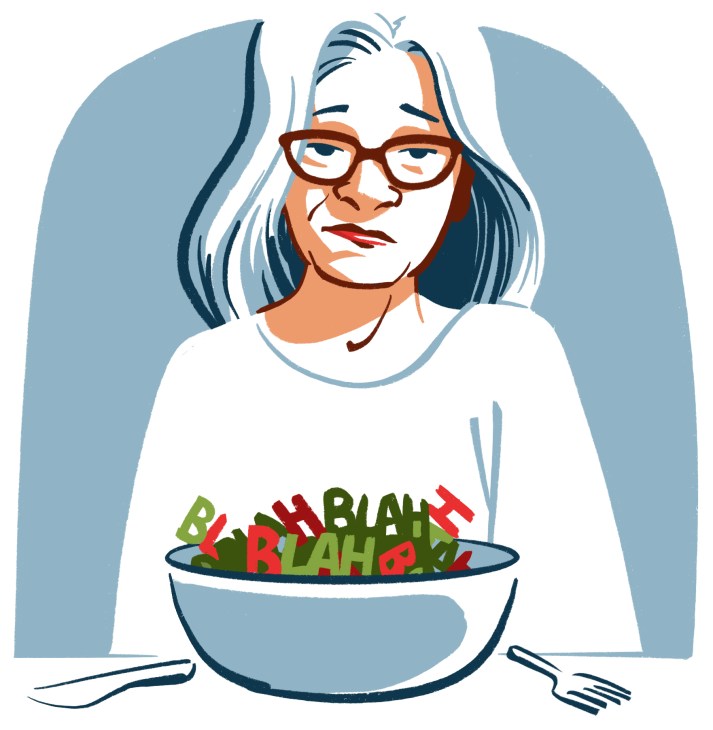
What I’m proposing here and in my recent book on the subject is the practice of thoughtful verb use. This is not a grand solution to impersonal and alienating language. Rather, it’s a discipline of small steps to add meaning, compassion and even joy to our discourse. Verbs are not only the secret soul of language. They are descriptive tools too. They spark imagery and emotion. One excellent verb can suggest a whole story. A jeweller’s website that I stumble across describes its turquoise as having “slipped from the sky”. An exaggeration, yes, but it conjures a harmless dream of magic and flight. A bus ad for a science museum in San Francisco urges, “Tinker, touch, test, experiment, notice, play!” And I’m hooked. I linger over “tinker” and “play” and see myself happily fiddling with levers and springs and possibly emerging from the gift shop with a deck of 3D cat cards and an ant farm.
Outside the creative sphere, strong verbs restore moral clarity. It takes humility to own the truth and say, “I made a mistake,” instead of, “Mistakes were made.” The passive voice sounds weak and evasive. Honesty lives in active, accurate verbs.
Yet the latter can feel risky when we’re accustomed to euphemisms. Corporate jargon turns “lay off” into odd nouns that hide the truth: “a simplified operating model”, “a strategic pivot”, “a rightsizing”.
Tell the plain truth in strong, clear verbs, however, and you can gain widespread praise. Airbnb’s CEO, Brian Chesky, discovered this in 2020. Facing the coronavirus pandemic’s chokehold on travel, he wrote a straightforward letter to employees. No doublespeak: nearly 1,900 of them “will have to leave Airbnb”. He chose blunt verbs and compassionate ones (“We will have to part with teammates who we love and value”). Chesky also stated his aim “to take care of those that are leaving”. Some responded on social media with gratitude for his manner and a tone so refreshing that the news media took note.
Verb choice shapes our relationships. In the 1960s, psychologist Marshall Rosenberg developed Nonviolent Communication, an influential training programme to foster empathy and avoid conflict. A key strategy is to make “I” statements with active verbs expressing specific observations, not generalities. “You’re always late for meetings” prompts defensiveness. “I noticed that you came in late twice last week” might invite a conversation.
“Honour the verb” is a cherished tenet of journalism: do so and you honour your audience. AI hasn’t learnt this. A self-described “book-marketing specialist” recently sent me a pitch via email, offering to promote my style guide on verbs in attention-grabbing ways. But they hid the point in bot-generated word sludge: “In reviewing the current presentation, I noticed opportunities where the emotional intelligence of the book could be reflected more intentionally across its discovery structure. That creates an unusual discoverability challenge…”
You bet it does.
Vague, maddening garbage such as this is spreading so quickly that you might fear that it’s unstoppable. But it’s not. Ignore the bloodless LLM rumble. Let’s slow down, consider what we mean to say and choose natural language with the clearest words – starting with a subject, a verb and the truth.
About the writer:
Sarah Kaufman is a Pulitzer Prize-winning critic, a writing teacher and the author of Verb Your Enthusiasm: How to Master the Art of the Verb and Transform Your Writing. Her work also appears in the New York Times, Wall Street Journal and Washington Post.
Belgian pop favourite Angèle on how the Paris Olympics’ stage transformed her career
Dressed in a black catsuit, Belgian pop star Angèle emerges from a smoky haze of red and blue to the sound of pounding beats. It’s the closing ceremony of the 2024 Paris Olympics and the audience is cheering. She is on stage to perform French electro act Kavinsky’s “Nightcall”, along with indie band Phoenix. It’s a crowning moment in her career.
Though the ceremony marked Angèle’s entry into the international pop pantheon, the Brussels-based musician was already a superstar in the Francophone world. Her debut album, Brol, was a bestseller in France in 2019 and was accompanied by a sold-out tour. That year her single “Balance ton quoi”, which details the everyday sexism that women endure, became a defining song of the “BalanceTonPorc” (“Denounce your pig”) movement – the country’s equivalent of MeToo.
It has been almost five years since Angèle’s most recent album, Nonante-Cinq, but she has recently started releasing new music, most notably “What You Want” with French duo Justice. Here, she tells Monocle about her love for Belgium, writing political songs and where you’ll find her relaxing this summer.
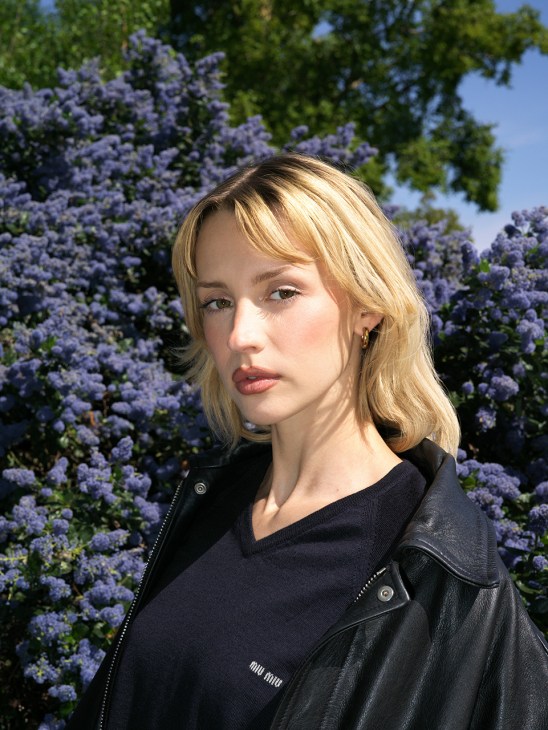
One of your best-known songs, ‘Bruxelles je t’aime’, is a love letter to your home city. What does Belgium mean to you?
It’s a crazy little country that has so much to offer. Being Belgian involves knowing how to make fun of yourself because nothing is ever that serious. I love that.
You grew up in an artistic family and your parents are famous in Belgium [Angèle’s father is the singer Marka and her mother is comedian Laurence Bibot]. How has that influenced you?
My parents were so supportive. Seeing them in their dream jobs, I grew up with the audacity to think that it was the norm. I always knew that I wanted to be in control and not get stuck in situations that I wasn’t happy with. I have had some bad experiences with the industry but have always been very independent. I created my own label and my own publishing company.
You have toured with Belgian-Congolese rapper Damso. What was that like?
It was magical. Now he’s a huge artist but I saw him at the beginning of his career and he saw me at the beginning of mine. Opening for him wasn’t always easy because his audience was into rap; they weren’t ready to see me. It was probably the most humbling thing that I have ever done but it was important to learn that nothing is guaranteed and you have to fight. Damso and I have collaborated many times and we’re good friends. He’s a brilliant artist and a very philosophical person.
And what about the closing ceremony of the Paris Olympic Games?
It was actually a last-minute thing. I was on holiday in Italy when I got the call. To be honest, I freaked out as I hadn’t been on stage for about a year. I asked for some time to decide and my managers encouraged me to do it. They knew that it could change my career.
At the ceremony, you sang a cover of Kavinsky’s ‘Nightcall’ and you have since released the song ‘What You Want’ with Justice. What’s your relationship with electronic music?
It has always been part of my life. I just love the roundness of synths and the sharpness of the bass and beats. Something that I love about [electronic-music genre] French touch is the importance of melody and chords. You can even hear chanson française chords in some Daft Punk and Justice songs. When Phoenix asked me to do “Nightcall”, it felt like a chance to connect with a song that I had grown up with.
Your song ‘Balance ton quoi’ soundtracked the French MeToo movement and the video is set in a satirical anti-sexism academy. Do you ever feel nervous about being politically outspoken?
There’s no doubt that it’s a political song, especially when you see the video, but when I wrote it, it was just my train of thought. I had been harassed on the subway that day and wanted to say something about it. When we made the video, I knew that I had to be serious about what I was saying. I worked with Belgian artist Charlotte Abramow and am proud of what we did. If I had to make a video like that today, I would freak out because I would think that it was too bold. I love how carefree it feels.
Your songs feel very intimate. To what extent do you write from your own experience?
My song “Ta Reine” is about two girls falling in love – well, one girl falls in love and the other is a little unsure. My best friend was going through something similar and I felt connected to that story too. When I got outed by the press [a tabloid magazine published photos of Angèle and her then girlfriend in 2019], I faced homophobia and it was shocking. But it was interesting how it suddenly felt as though I had written ‘Ta Reine’ for myself.
Where will we find you this summer – and what will you be listening to?
I’m not ready to tour so I’ll be relaxing. Brussels is amazing in the summer because it’s hot but still feels fresh. I’ll spend some time in New York too. Right now, I’m listening to European artists such as Amaia, Zara Larsson, Pink Pantheress, Theodora and Rosalía. Amaia recently did a Tiny Desk Concert [for US radio station NPR] where she played the flute with a chair. It was genius.
Global conflict sets a tone of controversy and contention at this year’s Venice Biennale
The day before the Venice Art Biennale opened to the public, a lone woman stood outside Russia’s pavilion. Her fedora, striking checked suit and sunglasses made her conspicuous but it wasn’t her style that kept a steady stream of smartphones and TV cameras pointed in her direction. On her back was a sign that read “No Putin No War”. The bright-blue Birkin bag swinging idly from her arm was emblazoned with a crossed-out illustration of the Russian leader’s face. “I’m protesting for all those who can’t,” she said, when asked about the bold action.
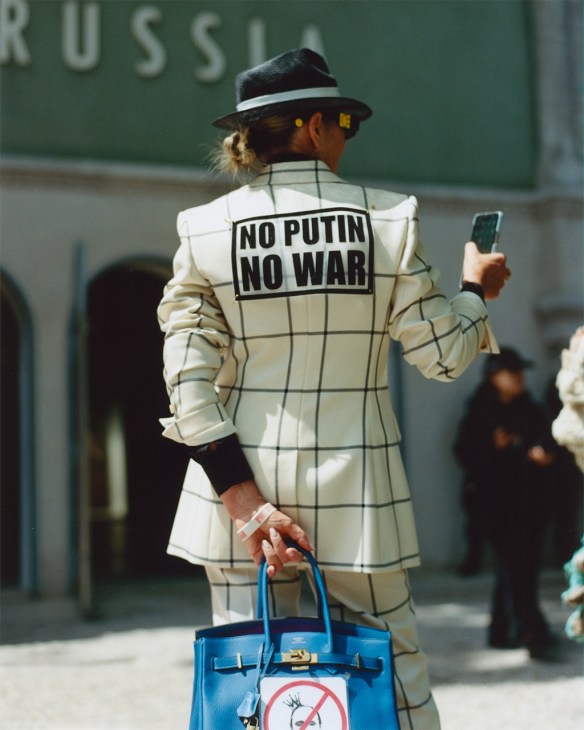
This was far from the only protest at Vernissage, the Biennale’s preview days for press and VIPs in early May. Feminist performance group Pussy Riot managed to shut the Russian pavilion temporarily when they arrived outside it wearing hot-pink balaclavas and wielding fuchsia flares. Elsewhere, the Solidarity Drone Chorus created a mobile demonstration of performers humming a viral song by Ahmed Abu Amsha, a music teacher from Gaza, accompanied by recordings of unmanned aerial vehicles. T-shirts worn by those taking part bore the names of Palestinian artists, many of whom were killed by Israel in the recent conflict. These activists turned their messages into haunting artworks: throughout the week, they were reported on as much as anything that hung on a pavilion wall.
The main focus of protests this year was the presence of Russia and Israel at the event, and the dissent culminated in a strike organised by the Art Not Genocide Alliance group (ANGA). On the final day of Vernissage, about 18 pavilions closed to visitors as part of the action – unprecedented in Biennale history. But while this year’s preview was an explosive assembly of activists and art cognoscenti, the complications started long before.
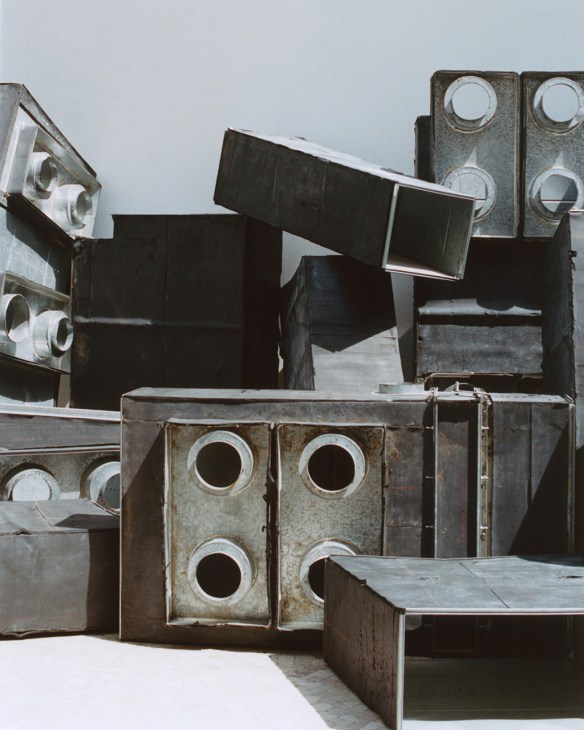
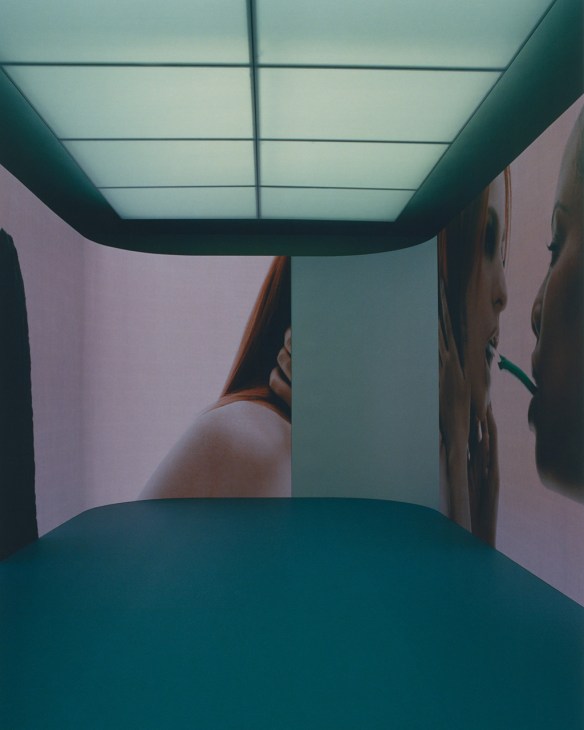
This 61st iteration of the Venice Biennale was put together by Cameroonian-Swiss curator Koyo Kouoh. She made history as the first black woman to take on the task but her role was cut short by her death in May 2025. While she chose the theme – “In minor keys” – it was up to the curatorial team that she assembled to oversee its execution. Just before Vernissage, the five-person jury that Kouoh appointed resigned in protest at the inclusion of the Russian and Israeli pavilions. Italy’s government also expressed its opposition to the former’s presence and announced an investigation into whether it might be in breach of EU sanctions.
While disputes and demonstrations might have dominated the news coverage, the works on show haven’t gone unnoticed. In the Giardini, Austrian artist Florentina Holzinger has created the most talked-about pavilion. Her exhibition, Seaworld Venice, extends beyond the building to include a topless performer dangling outside, becoming both a human clapper suspended in a giant bell and a striking advertisement for the presentation taking place inside. There, Holzinger’s company perform stunts nude on jet skis and take turns to be submerged in a glass tank surrounded by filtered urine from two adjacent Portaloos (open for use by visitors). Elsewhere in the Giardini, sperm banks, babies and belonging are the subjects of some of the most compelling national pavilions.


Here, artistry isn’t just contained in the main sites of the Biennale but floats and flows along Venice’s canals, in churches and gardens around the city, and across to neighbouring islets. From the boat en route to one of these – the tiny San Giacomo island – the first thing that you spot is a flock of bulbous, disembodied eyes fluttering in the wind. These omniscient kites are part of an installation by UK artist Matt Copson, marking the opening of San Giacomo.
At various points from the 11th century, the island has been home to a church, a military garrison and a vineyard. In 2018, San Giacomo was bought by the Italian Fondazione Sandretto Re Rebaudengo and it has now been transformed into a public art space with permanent sculptures and two galleries. There is also a private home for the organisation’s founder, Patrizia Sandretto Re Rebaudengo, with interiors designed by Italian filmmaker Luca Guadagnino.

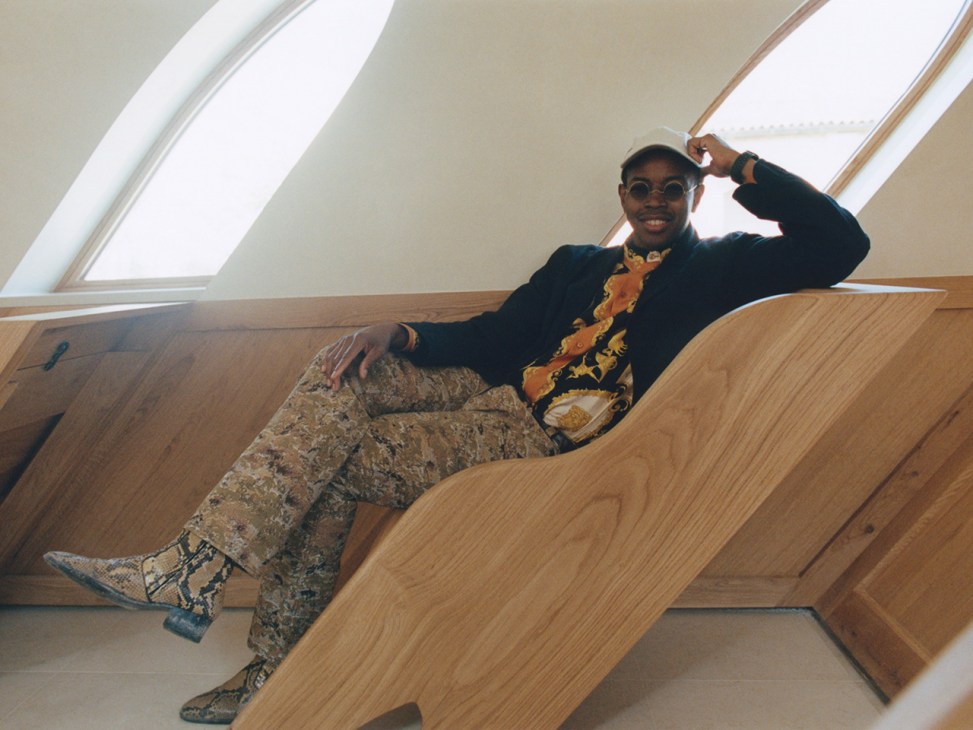
“It’s a place that actively responds to the work and, at the same time, the island resists total control,” says Sandretto Re Rebaudengo. “It asks artists to listen and respond. This often leads to art that focuses less on display and more on relationships with the natural world.” The floating eyes that hover over visitors enjoying lunch and glasses of icy rosé on the opening day rely on the wind to make their statement. So too does an enormous, monstrous black kite and a metal sculpture that creates a buzz as it moves with the elements.
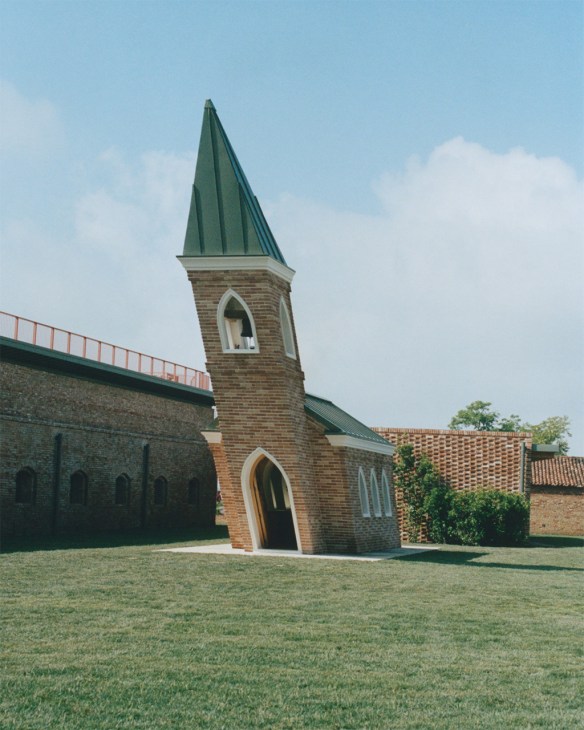
Many of the installations dotted around the island riff on the place’s history and landscape. “Huff and a Puff” by US artist Hugh Hayden – a full-scale place of worship, tilted forward at a jaunty 40-degree angle – nods to the past existence of a church here.
“All of the works reflect on questions that are central to San Giacomo – those of transformation, vulnerability, resistance and memory – and also the relationships between human and non-human systems,” says Sandretto Re Rebaudengo. “I think of them as a constellation, rather than a fixed curatorial statement. And I believe that the lagoon completes them.”
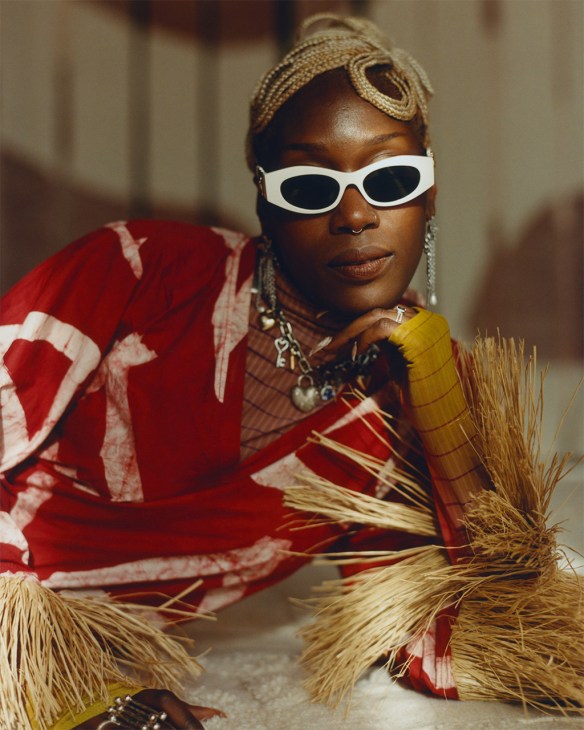
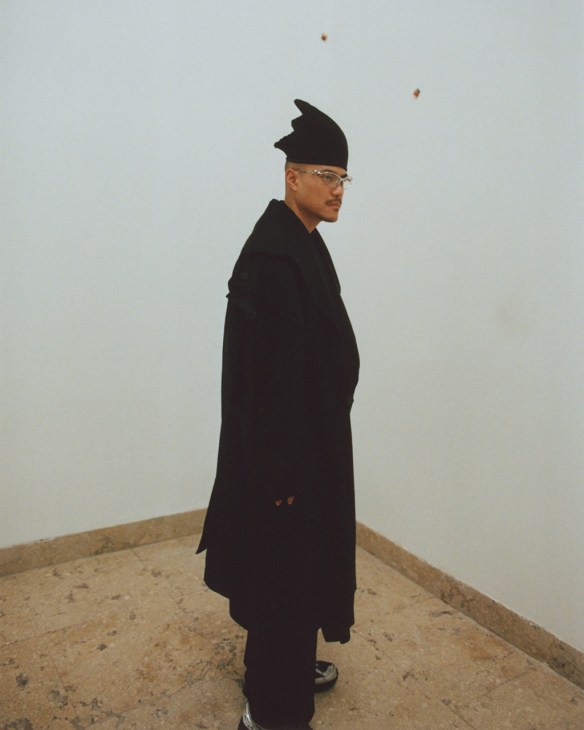
Back on the main island as evening falls, the Giardini and Arsenale begin to empty. Later, after dinner, the crowds reassemble outside palazzos. Extravagant outfits become home to sharp elbows as partygoers vie to enter exclusive events. At one, held by the Danish pavilion and Berlin-based arts platform Trauma, the Hungarian-Italian former porn actress, politician and pop star Cicciolina puts on a rare performance. Surrounded by flowers and wearing a matching floral crown, the septuagenarian provocateur’s disco ball of a dress competes for attention with her lip-syncing.
Outside, a green laser beams out from the island of San Clemente. This is an artwork entitled “Higher Power” by UK artist Chris Levine. Every evening this week, a militarygrade laser system shines a light upward. During testing, the beam was visible from the International Space Station. Further, bigger, better – perhaps it’s just another macho experiment in space exploration. Like the bulbous eyes on San Giacomo, it is, most of all, a reminder of the Biennale as a spectacle. The politics, the art, the people – everyone looking at what’s on show, watching each other or gazing upwards to follow a bright emerald light as it fades into the sky.
“It’s rare to find this kind of building in Paris.” Inside Antoine Ricardou’s Montmarte apartment
“I need to be in the sky,” says Antoine Ricardou, co-founder of Saint-Lazare, a design studio in Paris that has worked with brands such as Cartier and the Centre Pompidou. In the open-plan kitchen and lounge on the top floor of his three-storey Montmartre apartment, you feel as though you’re floating above the city. “I see it as a lighthouse,” says the architect and designer. “There’s a beautiful phrase in France for this kind of place: nid d’aigle – the eagle’s nest.” The room has a loft-like feel, with a pitched white ceiling, exposed beams and windows flanking both sides. Step onto the terrace and your gaze falls onto the Basilique du Sacré-Coeur, which is so close that you can almost touch it. “It feels very poetic when you hear the bell,” he says.
Though located in a quintessential Paris neighbourhood, this is far from your typical apartment in the French capital. Rather, the entrance and stairwell look like something that you might find in Milan: terrazzo floors, plywood walls and a spiral staircase that winds up four floors. “It’s rare to find this kind of building in Paris,” says Ricardou. Unlike much of the rest of the city, which Napoleon III tasked Georges-Eugène Haussmann to redesign in the mid-1800s, Ricardou’s building was constructed after the Second World War. Little money was available so its design had to be more about function than form: no ornamental façades and wrought-iron balconies, which, says Ricardou, resonates with his own ethos. “At Saint-Lazare, we try not to be decorative but narrative-led and functional.”
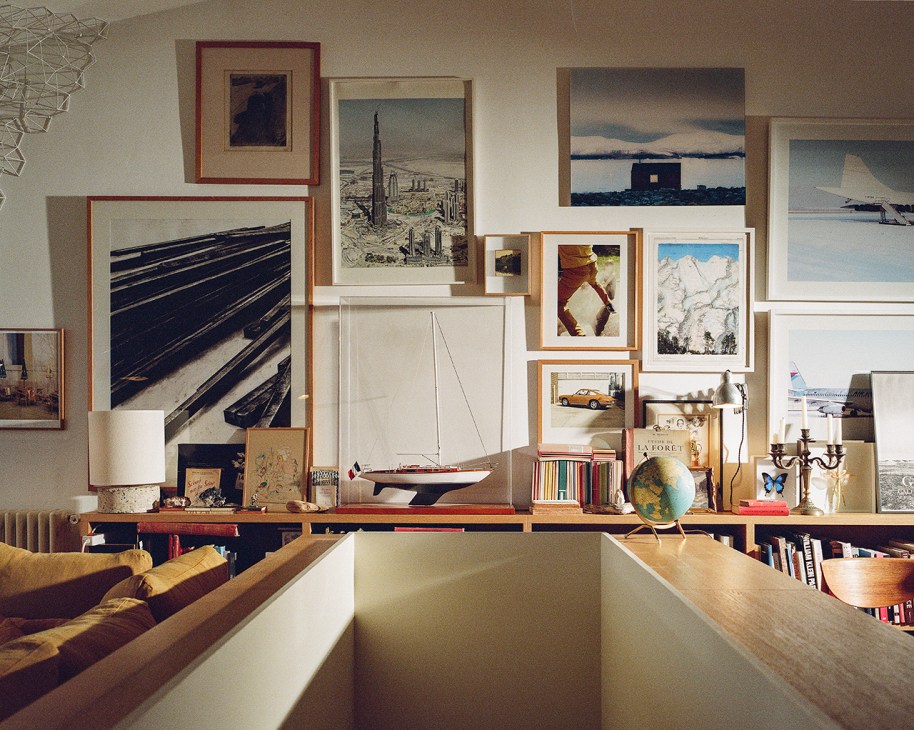
Ricardou has long been a fan of this mid-century style and immediately fell in love with the building when he first visited. But what drew him to this hilltop wasn’t simply the complex. He grew up in Montmartre, the neighbourhood where his great-grandfather had settled after emigrating from Germany at the end of the 19th century, purchasing buildings and pioneering development. “Montmartre was a little hill on top of Paris with no major construction, only eclectic houses for artists,” he says.
The area hadn’t yet been annexed by the city so, while Haussmann set about transforming Paris’s narrow streets into wide boulevards fronted by buildings with grand exteriors, Montmartre maintained its village-like feel. “It was quite audacious and risky,” he says of his grandfather’s decision to develop in an area that was far from popular. “You couldn’t have imagined that this district would become so renowned and beautiful.” Today his relatives still own a few apartments in the area, in buildings with the family name, Gries, engraved on the façade.
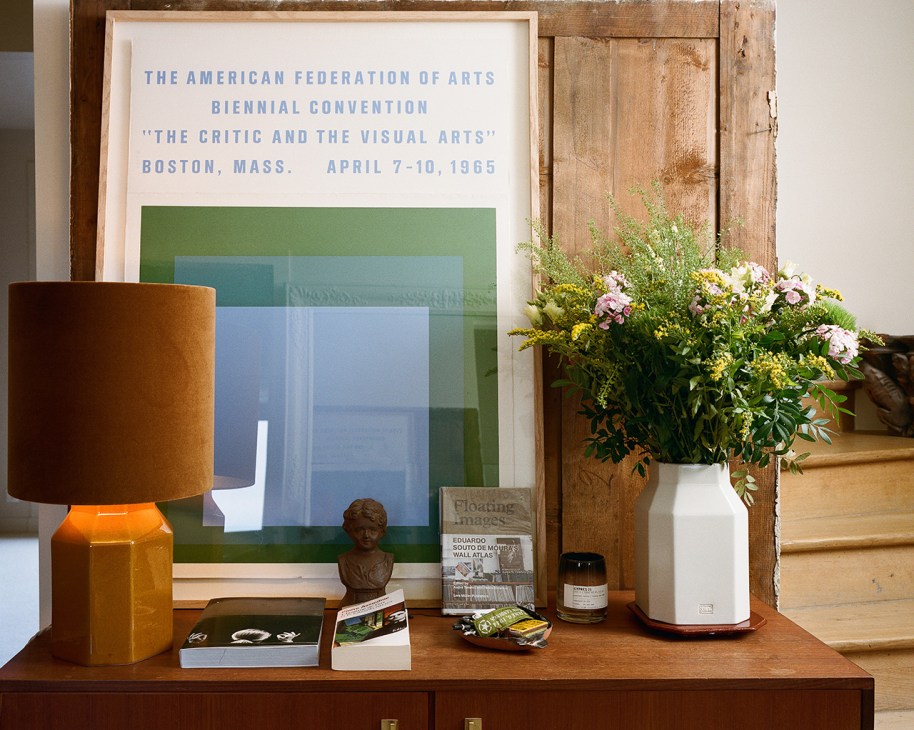
Ricardou has followed in his grandfather’s footsteps. He has acquired neighbourhood institution Au Rêve, a café and bar that first opened in 1921, plus his apartment, which was originally two separate residences before Ricardou combined them. He purchased the first apartment 15 years ago as a two-floor space, then acquired the one below, connecting them with a wooden staircase that drops from the entrance hall to two further bedrooms. “It’s 150 sq m, which is very big for a French family but not very big for a family of five people,” he says. The wood-panelled vestibule on the second floor is inspired by Ricardou’s childhood spent in the Pyrenees, as well as the plywood in the building’s entrance hall. “This floor is connected to this building’s aesthetic,” says Ricardou. Rather than using cheap plywood, which was common in the 1950s, he turned to oak for the wall panels and African okume plywood for the staircase. “The homely feeling is important,” Ricardou says, explaining that it’s best achieved through warm lighting. “Every little space should be well lit. There has to be an umbrella of light in a dark room.” On top of the credenza in the hall is a mustard ceramic Saint-Lazare lamp topped with a cylindrical shade, one of the products for which the studio has become known. “A good designer should start with designing a lamp,” he says.
On the same level, the main bedroom has a terrace with city views. The bed, set on a creamy wool carpet, is surrounded by wood panelling and shelving that holds stacks of books, framed photographs and more lamps. There’s also an office but the star of the level is the bathroom, with terrazzo floors, marble-tiled walls and windows that look out onto Paris. “If I were the architect of this building in the 1950s, I would have done the bathroom like this,” says Ricardou. The porcelain bathtub, which doubles as a shower, was sourced from a garden on the western side of Paris. It’s now dressed with heavy, dark-mustard curtains that can be drawn during the colder months, which is what people living in this apartment would have done in the mid- 20th century. “It was a technique that you can find in old castles and houses, which were impossible to get too warm,” he says.
While one set of wooden stairs on the entrance level leads you straight to the lower bedrooms, the other takes you to the top floor, where Ricardou’s family members spend most of their time. To get there, he leads Monocle all the way up the narrow staircase, moving from the dark, moody entrance to a bright, loft-like space, crowded with books, paintings, photographs and objects.
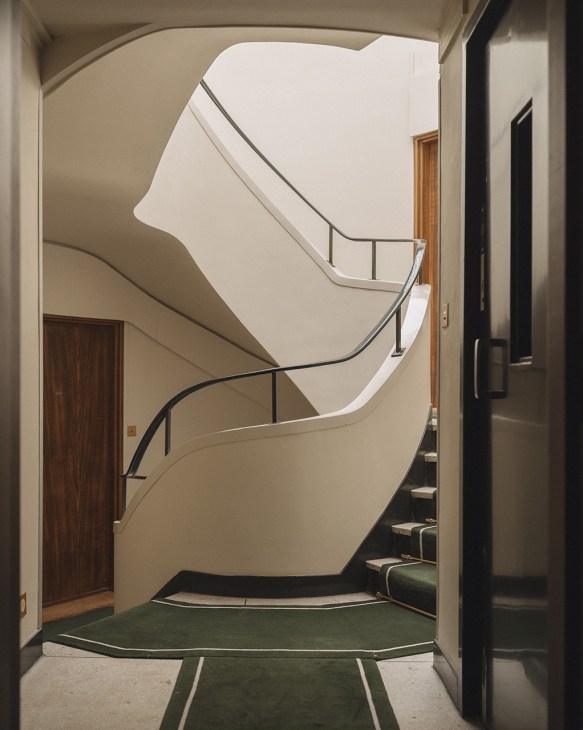
This is the heart of the home, where Ricardou’s wife, Gwenaëlle Grandjean, and their children like to gather around a large table that doubles as a kitchen counter and workspace. “I love drawing while my kids are in the same space,” he says. “Or we’ll cook together here.” One person might be working while another prepares dinner but the point is that they’re together, even when they are not actively engaging.
In the living room, Ricardou’s love for mid-century design is on show: there’s a 1960s table by Johannes Andersen, with teak wood chairs from 1965 by Danish designer Peter Hvidt. Above it is a lamp by Denmark’s TH Valentiner. In the lounge area sit rope armchairs created by French modernist designer duo Audoux-Minnet in the 1940s. On one shelf is a sailing boat model by Yves Gaignet, a yacht-model specialist based in La Rochelle. Proudly displayed in a light box, the object is a replica of Ricardou’s own sailboat, The Tina, which was designed by Dick Carter in 1969. “We restored the boat ourselves and it now sails in the Mediterranean,” he says. “Having this model in front of me allows me to escape and sail a little in my mind.” Other pieces include an image by Belgian photographer Harry Gruyaert and a drawing by conceptual artist Bernar Venet.
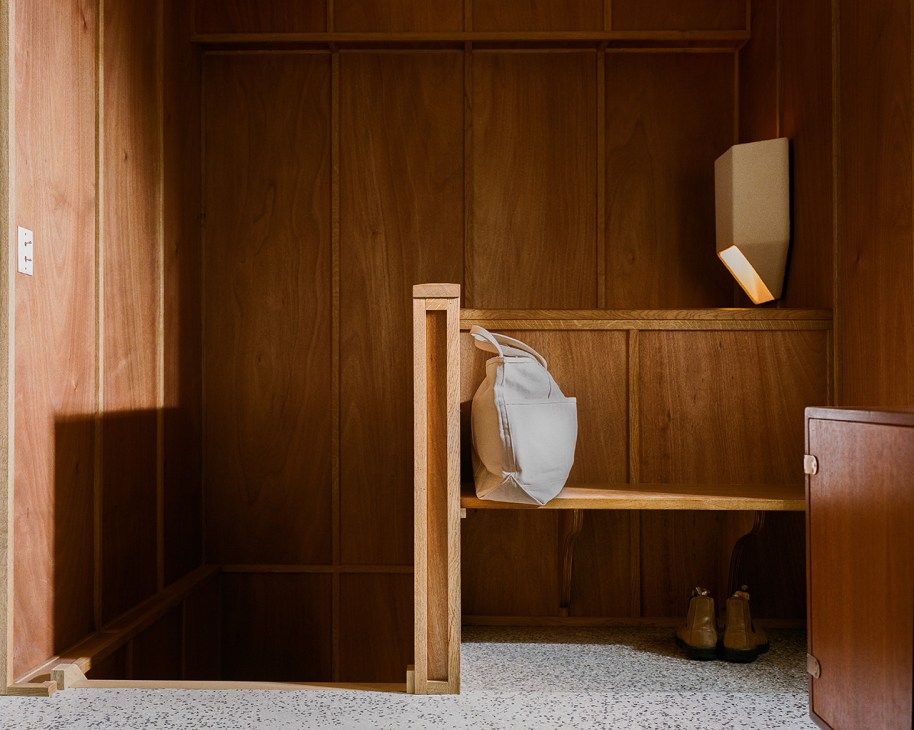
After curating the artworks for the Nomad Hotel in London, Saint-Lazare has established itself as a go-to name in art programming. This is evident on these walls, where varied works harmoniously coexist. “We have been collecting a lot of art, photos and drawings,” he says, noting that he often moves the pieces around. “We mix everything. We don’t hang things on the wall based on the price. It’s about our own private narrative.”
On this sunny day in Paris, the doors to the terrace are unlatched. If you look down, you see the building’s shared garden. Ricardou’s terrace is lined with plants – designed by his wife, who runs landscape design studio Atelier Lamarck – in a way that resembles a hedge overlooking the city. “It’s important for us to be surrounded by greenery,” says Ricardou. “Someone once told me that in Paris, it’s better to have a good balcony or terrace on the same floor, rather than a rooftop. It’s clever: you never go onto a rooftop but when you have a terrace connected to a room, it feels fully open.” With the doors flung open and the sun streaming in, the views of the city stretch out beyond the plants. From this vantage point, it feels as though Montmarte belongs entirely to you.
Rio’s extraordinary Costa Brava Clube began with a tent on the sand
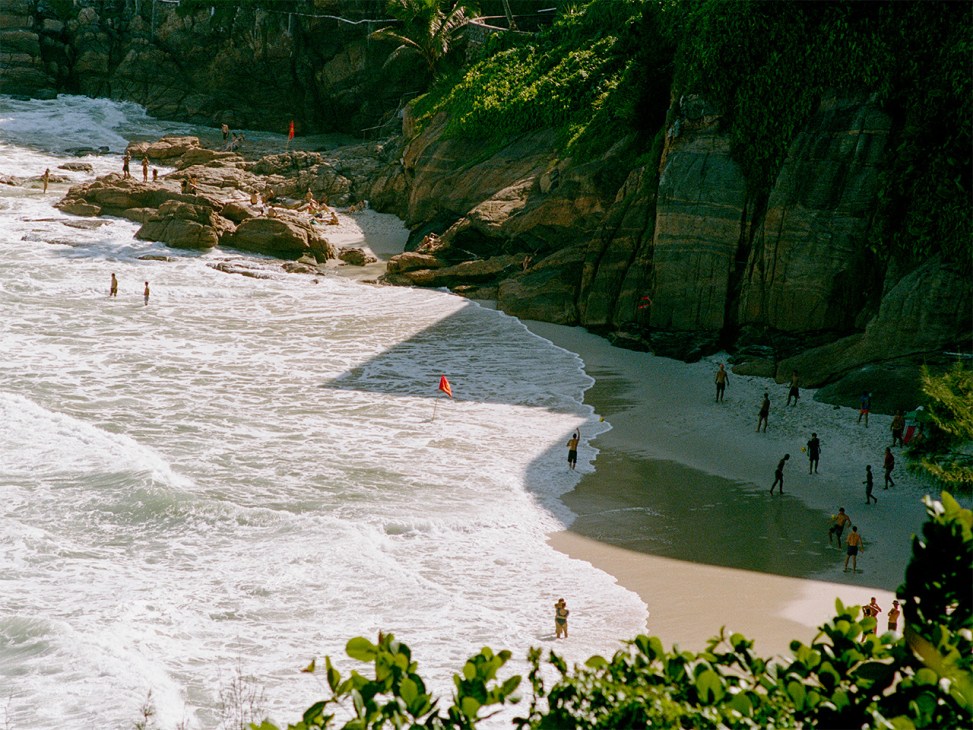
Drive south from Rio de Janeiro along the coastal roads and the route will soon start veering gently west, until you spy the Atlantic glittering beyond the white sands of Praia da Joatinga. It’s here, between the shores of São Conrado and Barra, that a 25-year-old architect, Ricardo Menescal, imagined what has become one of the city’s most enduring icons. “This place will be mine,” he is said to have muttered to one of his siblings during a 1960s camping trip during which they pitched their tent on the beach. “I shall build a club here.” And that’s precisely what he did.
The Costa Brava Clube, perched among the coves, cliffs and grottoes carved by the Atlantic waves, opened to members in 1962 – the same year that his younger brother Roberto, a musician, had a bossa-nova hit with the anthem “O Barquinho”. Both that song’s melody and the architectural harmony of Ricardo’s club remain symbols of a moment of hope, creativity and a redrawing of the Carioca character that echo to this day.
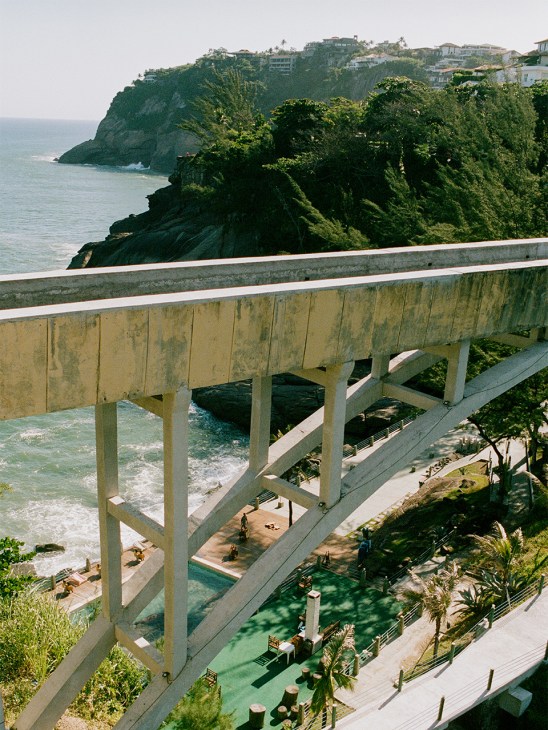
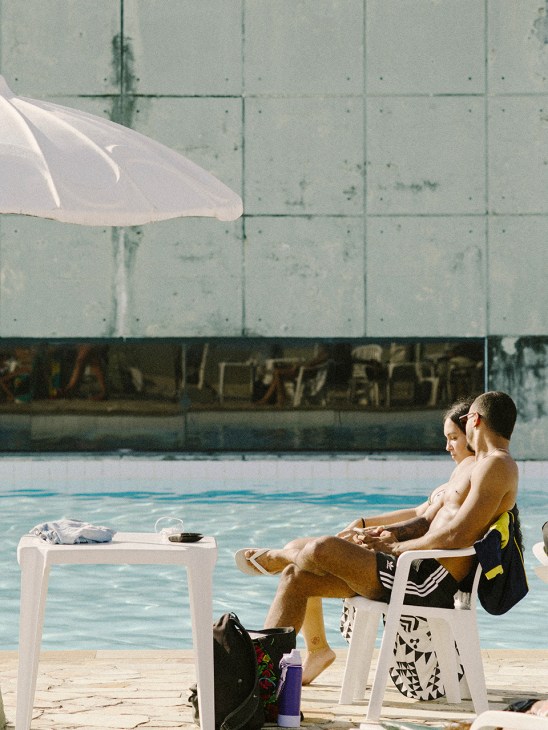
The club was erected on Ponta do Marisco (“Seafood Point”) – the furthermost point jutting into the sea. Through the sale of membership bonds, Ricardo secured enough members, to provide him with sufficient resources to realise his vision. His goal was to create a club that would foster a sense of community among those living close to the Joá cliff.
Its construction started with a horizontal, curvilinear residential building that was adapted to the terrain (it probably wouldn’t have met today’s building regulations). A concrete fortress dedicated to leisure and pleasure, the club comprises function rooms, restaurants, ballrooms, thermal baths, a spa and a terrace with a swimming pool that offers beautiful views of the Cidade Maravilhosa’s now popular – but at the time undeveloped – coastline.
Central to Ricardo’s plans was a question that many designers struggle with: can you improve on nature? And how can an architect enhance its beauty? Many cities are made attractive by the built environment but this Atlantic outpost of almost seven million people offers breathtaking landscapes, beaches, forests and mountains. Look closer, though, and there’s also a strain of architecture that feels as Cariocan as Ipanema, the dramatic Sugarloaf mountain or the cool embrace of the waters of the Lagoa.
By the 1950s, the Rio that we know was taking shape as a place of experimentation, creativity and pleasure. Unlike powerful Brasília or business-minded São Paulo, there was space here to blur lines, to seek harmony between buildings and nature.
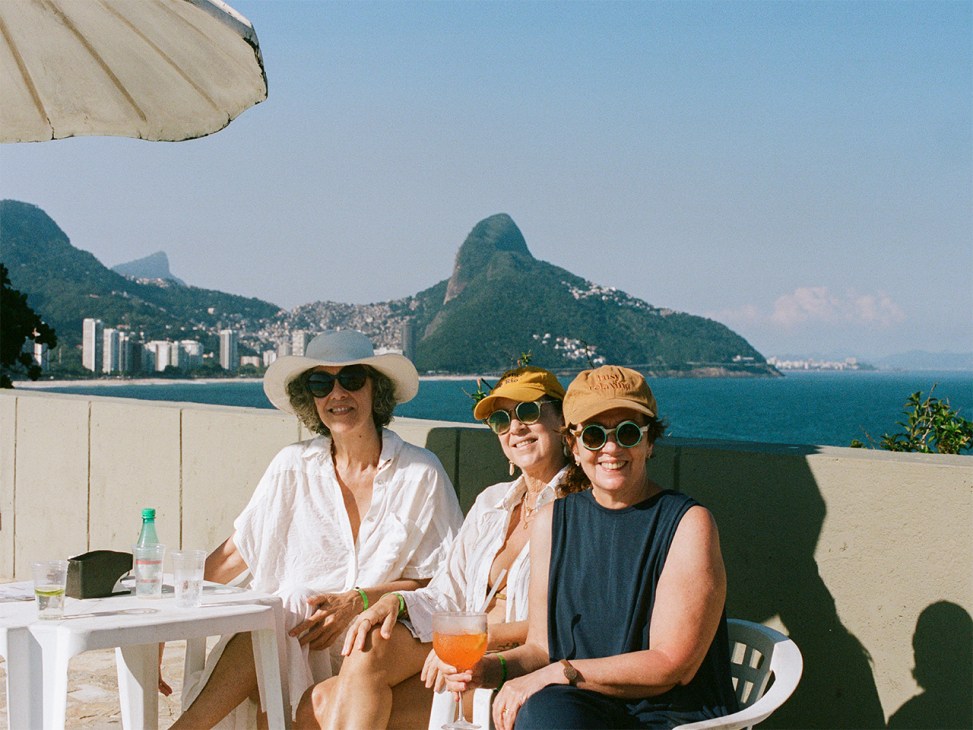
“Seu” Madureira was the site foreman at Costa Brava during the club’s construction in the early 1960s, when he co-ordinated teams of workers. He recounts the astonishment of Joá’s residents at the creation of the access bridge to the club, spanning a 96-metre gap over an isthmus with a post-tensioned beam – a method so ambitious and complicated that, to this day, it’s typically only feasible in vast public projects.
Madureira, who is endlessly fascinated by the structure that he helped to build and maintain, oversees the upkeep and booking of the sports courts. As one of the oldest and longest-serving members of staff, he is quick to share insights and knows every detail of the building. He’s also rather popular, as Monocle finds out on a visit, amid hails of praise and cries of “Bom dia!” (“Good morning!”). Madureira recalls with joy Ricardo’s creativity in inventing a system for capturing and pumping seawater into the swimming pool near the beach.
In some ways, the club’s heyday was in the 1960s and 1970s, when membership bonds were fiercely contested and its daring architecture was considered novel. Costa Brava still has about 800 members. For decades, however, its fortunes have waxed and waned. Eduardo “Duda” Gurgel, the current president, is today busy restoring the lustre of the past with some sense of why the place still matters and what it stands for. Is it an architectural oddity? A modern amenity? A failed utopia?
Fascinated by the club’s history, Gurgel guards a treasure trove of old photographs and the building’s original technical drawings. He says that condominium towers – a style of building that came to define the city’s postwar look – once also housed pools and amenities such as saunas and spaces for residents keen to meet and socialise. Alas, no more.
Beyond his architectural achievements, Ricardo was an energetic entrepreneur and adventurer. He was a pioneer of mountaineering in Brazil and founded the nation’s first hiking and camping club. He undertook some of the most difficult ascents of Sugarloaf Mountain – a neat metaphor, perhaps, for surmounting nature while respecting it. After the success of the Costa Brava, Renato, the youngest of the four Menescal brothers, joined Ricardo to design more than 50 other clubs. More than a decade after the latter’s death in 2002, Costa Brava Clube – a building deemed radical by some and strange by others – was recognised as part of the city’s cultural heritage. His name now graces the handsome belvedere on the Joatinga cliff where he first saw the site that inspired him to build. A memento of a creative flash.
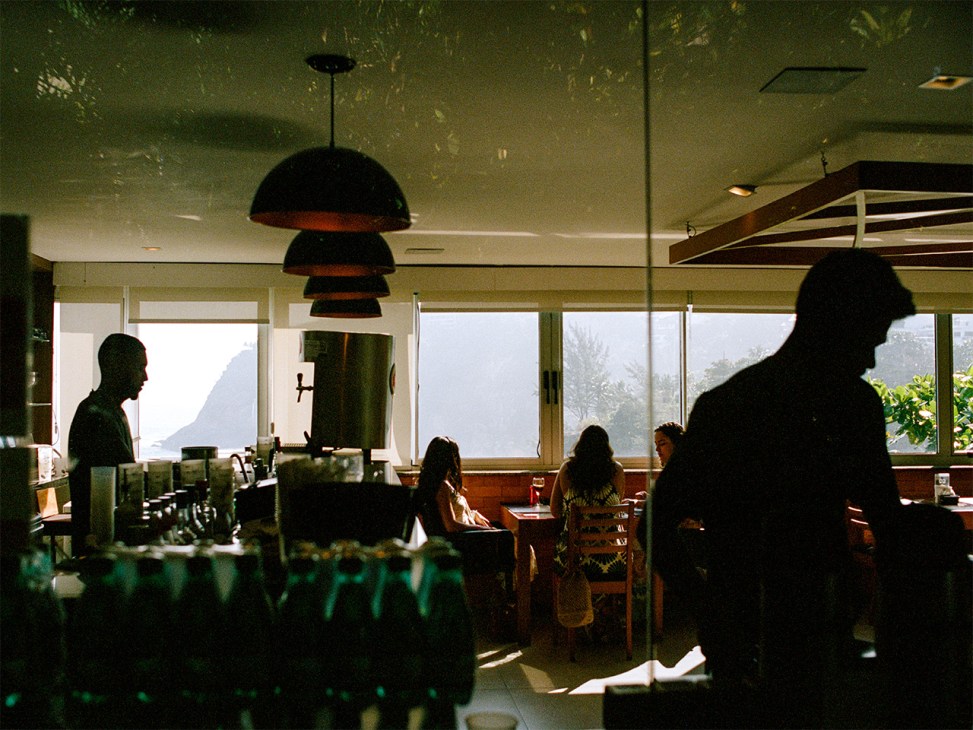
The club today might be time-worn but something of the optimism of the original design remains. Yes, there are the snaps of long-ago parties and delirious carnival balls to pore over, but the success of the structure can’t be captured in faded photographs. When Monocle visits, young couples play in the saltwater pool, while scuttling children and the elderly are united by bronzed bodies and a feeling more vigorous than mere nostalgia. You can imagine that sun-soaked heyday and mid-century optimism. Swap that funky soundtrack for some bossa nova, narrow your eyes to the midday sun, and you could easily believe you were back when this adventure began.
Editor’s letter: Andrew Tuck on the booming business of coffee
The world can be divided into just two types of people: coffee devotees and tea drinkers. I am a proud member of the coffee tribe and, frankly, harbour a distrust of anyone who outs themselves as a lover of the teapot and all the stewed, tannin-laced evil that can spurt from its spout.
Coffee is about speed, energy, focus. It’s about having a stand-up espresso in a Milanese café, surrounded by people in good suits, or sitting outside a Sydney café enjoying another flat white with ready-for-fun friends. Coffee is also about well-designed cafés, clean aesthetics. And tea? Well, tea is all about becoming a permanent resident of Sleepy Town. It’s a world of slipper-wearers who say things like, “What I need is a nice cup of tea and to put my feet up.” Yes, bubble-tea bars and matcha cafés have proliferated but these are drinks that obscure their tea element using fruity flavours or Day-Glo green colouring. Really, if you need to get anything done, make sure that you find a coffee drinker.

And it seems that much of the world agrees with me. Certainly, the money people do. The coffee shop has become one the hottest investment sectors for venture capitalists, alcohol businesses trying to diversify and community-building fashion brands (you may have also noticed a media company close to my heart that likes to take care of its coffee-drinking readers).
And you can see why. A good coffee shop has universal appeal and has cut through in wealthy markets such as the UAE and Saudi Arabia, where socialising often takes place over a coffee, not with booze. The audience is young, design-aware and ambitious. So if you can create a cool brand, it’s possible to grow a healthy business. And it’s this latest iteration of the coffee trade that we pore over in this issue. We’ll meet the biggest players (China’s Luckin Coffee now has 30,000 outlets) and guide you to 25 of our favourite cafés around the globe.
This magazine also contains two further surveys. The first is our annual examination of the world of art and collecting, in which we meet seven players with deep insights into very varied sectors of the market, from rare posters and antiquities to contemporary art. Collectors are motivated by many things: obsession, passion, money. Perhaps the most fascinating part of our report is the unpacking of the cravings that drive people to fill their homes with objects and art.
US gallerist Easy Otabor, for example, tells Monocle that he has always collected. First it was training shoes. Now, with the art that he buys, he asks himself, “Are these [works] by good people? Would I enjoy having dinner or working with them?” Meanwhile, Pertti Männistö has gathered one of the world’s largest Alvar Aalto furniture collections. Over the past 30 years he has put together an array of pieces so large and of such significance that only a tiny portion of them will fit in his house, with the rest now in storage. Yet he continues searching for rare prototypes.
Then there’s the Class of 2026 Expo, masterminded by our editor, Josh Fehnert. He’s worked with Monocle’s writers and correspondents to spotlight 16 rising talents in everything from photography to architecture and cartography. Why? At a time when many media organisations focus on the negatives – what divides us – we wanted to put the spotlight on people forging ahead, tackling issues and delivering change, with hope and ambition. It’s a very uplifting conclusion to this issue. And I imagine that there’s a lot of coffee drinkers among them.
If you would like to drop me a note, please feel free to send thoughts and ideas to [email protected].