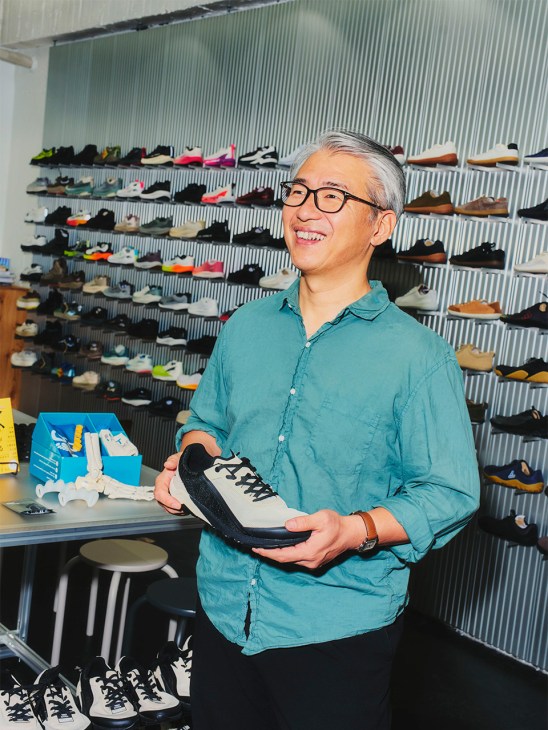
Step by step, Stride Group’s Takashi Fukuchi is reshaping the way that we move and the shoes that we wear. Since 2016, the Tokyo-based entrepreneur has been building Stride Lab, a network of shops that specialises in running gear and zero-drop shoes – a footwear design that places the heel and forefoot on the same level. Along the way, he has become the distributor of brands including Denver-based Altra, while creating new ultra-light-shoe brand Notace, which was launched in 2025. Designed to support the body’s natural movements, its shoes provide balance and comfort, plus an amplified sense of ground contact.
Stride Group has seen a 30 per cent increase in year-on-year growth, with annual revenue predicted to reach ¥3.5bn (€18.8m) by the end of this fiscal year, all without the aid of outside investment. The entrepreneur plans to increase Stride Lab’s retail footprint; it will have one shop in the US, two in South Korea and 20 in Japan by 2027. He aims to have 100 Stride Lab shops in his home country within the next decade. Monocle stops by the Stride Lab flagship in Nihonbashi to find out more.
How did you become involved in the shoe industry?
My background is in physiology and I have been involved with the health industry for a long time. One day, at an outdoor retailer show in Utah, I met the gentlemen who started the shoe brand Altra. Their background was in biomechanics so, while other brands were talking about cushioning and performance, their focus was on how to run more healthily. I was surprised and even though I had never been in retail or wholesale before, I decided to become their distributor in 2011.
What motivated you to open the first Stride Lab shop in Tokyo in 2016?
For a few years, I insisted that people should wear zero-drop, foot-shaped shoes. They look quite different to conventional footwear and it wasn’t easy for people to understand why they were better. That’s why I opened the first Stride Lab shop and trained the staff to grasp the importance of choosing the right shoe to meet people’s needs. It was an immediate success.
Our Tokyo flagship has a basement training facility where we assess people’s foot strength, based on a foot-health index that we created from more than 1,000 tests. Our foot-health programme is led by a trainer who worked with the Tokyo Yakult Swallows baseball team and also teaches professional strength coaches and trainers effective testing protocols and exercise prescription. We’re not only selling footwear. Shoes are great but they don’t magically make you healthier. We also need to educate people about the natural movements of their feet and their whole body.
What does Notace aim to bring to the market?
After working with many different brands and requesting a particular kind of shoe without success, my co-founders and I decided to do it on our own in 2024 [before officially launching in 2025]. We knew the shape, construction and cushioning required. We removed all of the unnecessary parts to simplify and reduce the shoe’s weight. The next-generation ETPU [expanded thermoplastic polyurethane] midsole is an important feature. It’s not only lightweight but provides both protection and flexibility too.
When we set out to create our shoes, we didn’t rely on modern, maximalist technology. Instead, we looked to ancient wisdom – specifically, to waraji, the traditional Japanese sandals woven from rice straw that travellers and marathon monks wore across rugged terrain for more than 1,000 years. Studying this type of footwear was a brilliant, centuries-old masterclass in biomechanics. Traditional waraji were woven to a thickness of about 15mm to provide just enough protection to take the edge off impacts, while letting the foot feel the earth. They were also flexible, as they were made from straw. To replicate this, we build our shoes to be highly pliable. They move with your stride, never against it. Your foot has 26 bones and 33 joints. Each has a specific function. Our shoes are designed to allow them to move naturally. Waraji were also shorter than the foot, allowing the toes to hang off and grip the ground directly. We designed a wide toe box and flexible forefoot to give toes the room to splay and engage with the trail. Whether you are walking, running or standing, to keep your posture right, every movement needs ground stability. In Japan, people used to be offered giant waraji shoes at temples to pray for strong legs and feet. It’s a culture that honours the body’s inherent abilities. Notace was born from this philosophy.
How can wearing the correct shoe improve people’s everyday lives?
Stride Lab believes that footwear is the foundation of a healthy life. A major cause of declining health is a lack of daily exercise, which is often caused by pain. When our feet or lower back hurt, we move less. While experts recommend walking 8,000 steps a day and engaging in light exercise, doing so consistently requires pain-free feet. That is where choosing the right shoes becomes crucial.
Numerous studies show that regaining lost foot function and strengthening your feet can help to prevent future internal diseases. We address this by restoring foot function so you can keep moving. We design shoes that help to rebuild the natural strength of your feet. We focus on the perfect fit for every individual.